


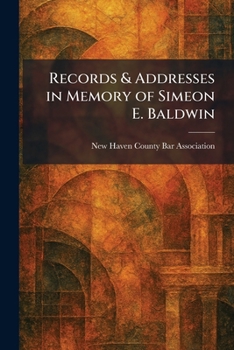
Records & Addresses in Memory of Simeon E. Baldwin

"Records & Addresses in Memory of Simeon E. Baldwin, 1840-1927" is a commemorative collection dedicated to the life and enduring legacy of one of Connecticut's most prominent legal and political figures. Compiled by the New Haven County Bar Association, this volume brings together the formal addresses and tributes delivered in honor of a man who served with distinction as both the Chief Justice of the Connecticut Supreme Court and the state's 65th Governor.
The work provides a profound exploration of Baldwin's contributions to American law, education, and public service. As a foundational figure in the American Bar Association and a long-tenured professor at Yale Law School, Baldwin's influence reached deep into the fabric of the American legal system. These records detail his intellectual rigor, his dedication to judicial excellence, and his unwavering commitment to the public good during a career that spanned nearly seven decades.
Through these professional tributes, the reader gains insight into the historical development of the Connecticut judiciary and the evolution of legal ethics. This collection stands as a significant historical document for researchers of 19th and early 20th-century American law and the biographies of New England's governing elite.
This work has been selected by scholars as being culturally important, and is part of the knowledge base of civilization as we know it. This work was reproduced from the original artifact, and remains as true to the original work as possible. Therefore, you may see the original copyright references, library stamps (as most of these works have been housed in our most important libraries around the world), and other notations in the work.
This work is in the public domain in the United States of America, and possibly other nations. Within the United States, you may freely copy and distribute this work, as no entity (individual or corporate) has a copyright on the body of the work.
As a reproduction of a historical artifact, this work may contain missing or blurred pages, poor pictures, errant marks, etc. Scholars believe, and we concur, that this work is important enough to be preserved, reproduced, and made generally available to the public. We appreciate your support of the preservation process, and thank you for being an important part of keeping this knowledge alive and relevant.
Customer Reviews
ThriftBooks ® and the ThriftBooks ® logo are registered trademarks of Thrift Books Global, LLC
