


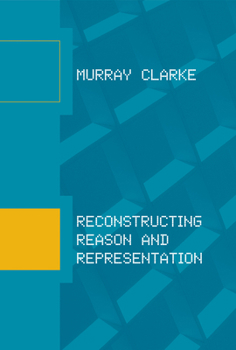
Reconstructing Reason and Representation
No Customer Reviews

Select Format
Select Condition 
Book Overview
A study of the philosophical implications of evolutionary psychology, suggesting that knowledge is a set of natural kinds housed in the modules of a massively modular mind. In Reconstructing Reason and Representation, Murray Clarke offers a detailed study of the philosophical implications of evolutionary psychology. In doing so, he offers new solutions to key problems in epistemology and philosophy of mind, including misrepresentation and rationality. He proposes a naturalistic approach to reason and representation that is informed by evolutionary psychology, and, expanding on the massive modularity thesis advanced in work by Leda Cosmides and John Tooby, argues for a modular, adapticist account of misrepresentation and knowledge. Just as the reliability of representation can be defended on the basis of an account of the proper function of cognitive modularity, misrepresentation can be explained through an appeal to the "gap theory," by noting the divergence between the proper and actual domains of cognitive modules in a massively modular mind. Clarke argues for an externalist, modular reliabilism by suggesting that evolution has equipped us with generally reliable inferential systems even if they do not always produce true beliefs. He argues that reliable deductive and inductive inference occurs only when cognitive modules deal with actual domains that are sufficiently similar to their proper domains. This psychologically informed, naturalized adapticism leads to the suggestion that knowledge is a set of natural kinds housed in the modules of a massively modular mind. Typically, the proper function of these cognitive modules is to provide us with truths that enable us to satisfy our basic biological needs. Beyond reasoning modules, other cognitive modules discussed include the ability to orient ourselves in space, and our abilities with language, numbers, object reasoning, and social understanding. Clarke also defends Cosmides and Tooby's massive modularity hypothesis against such critics as Jerry Fodor by demonstrating that these critics consistently misrepresent Cosmides and Tooby's position.
Format:Paperback
Language:English
ISBN:0262545756
ISBN13:9780262545754
Release Date:June 2022
Publisher:Bradford Book
Length:192 Pages
Weight:0.58 lbs.
Dimensions:0.4" x 6.0" x 9.0"
Age Range:18 years and up
Grade Range:Postsecondary and higher
Related Subjects
Behavioral Sciences Cognitive Psychology Consciousness & Thought Philosophy PsychologyCustomer Reviews
0 rating
Copyright © 2026 Thriftbooks.com Terms of Use
| Privacy Policy | Do Not
Sell/Share My Personal Information | Cookie Policy | Cookie Preferences | Accessibility Statement
ThriftBooks® and the ThriftBooks® logo are registered trademarks of Thrift Books Global, LLC
ThriftBooks® and the ThriftBooks® logo are registered trademarks of Thrift Books Global, LLC
