


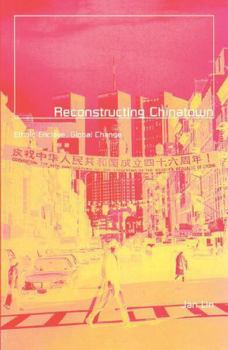
Reconstructing Chinatown: Ethnic Enclave, Global Change Volume 2

Select Format
Select Condition 
Book Overview
An exploration of this fascinating community as a window on globalization.
In the American popular imagination, Chinatown is a mysterious and dangerous place, clannish and dilapidated, filled with sweatshops, vice, and organized crime. In this well-written and engaging volume, Jan Lin presents a real-world picture of New York City's Chinatown, countering this "orientalist" view by looking at the human dimensions and the larger forces of globalization that make this vital neighborhood both unique and broadly instructive.
Using interviews with residents, firsthand observation, archival research, and U.S. census data, Lin delivers an informed, reliable picture of Chinatown today. Lin claims that to understand contemporary ethnic neighborhoods like this one we must dispense with notions of monolithic "community." When he looks at Chinatown, Lin sees a neighborhood that is being rebuilt, both literally and economically. Rather than a clannish and unified peer group, he sees substantial class inequality and internal social conflict. There is also social change, most visibly manifested in dramatic episodes of collective action by sweatshop workers and community activists and in the growing influence of Chinatown's denizens in electoral politics. Popular portrayals of Chinatown also reflect a new global reality: as American cities change with the international economy, traditional assumptions about immigrant incorporation into U.S. society alter as well. Lin describes the public disquiet and official response regarding immigration, sweatshops, and the influx of Asian capital. He outlines the ways that local, state, and federal governments have directed and gained from globalization in Chinatown through banking deregulation and urban redevelopment policy. Finally, Lin puts forth Chinatown as a central enclave in the "world city" of New York, arguing that globalization brings similar structural processes of urban change to diverse locations. In the end, Lin moves beyond the myth of Chinatown, clarifying the meaning of globalization and its myriad effects within the local context.Format:Paperback
Language:English
ISBN:0816629056
ISBN13:9780816629053
Release Date:July 1998
Publisher:University of Minnesota Press
Length:272 Pages
Weight:0.81 lbs.
Dimensions:0.6" x 5.9" x 9.0"
Customer Reviews
1 rating
Visit Chinatown but leave your stereotypes at the door
Published by Thriftbooks.com User , 20 years ago
Arguing that public perception of a group is ultimately subjective, Jan Lin (associate professor of sociology, Occidental College, Los Angeles) puts forth his research that how Chinatown is perceived rests largely on a westernized construct of what is 'good'. Using qualitative and quantitative research methodology he paints a much more empathetic and complex picture of New York City's Chinatown. Lin notes the groups inside these ethnic enclaves are not homogenous and have their own disagreements with each other over what direction is best for the community to follow. Including the information about intra-community transformation actions is important because 'white' society tended to portray Chinatowns as monolithic entities whose members intrinsically agree with one another. While such blanket stereotyping was prevalent in the past, it still continues because this work itself would not be as consciousness-raising as it is if society acknowledged this community's complexity. Lin examined New York's Chinatown, but his research is broadly applicable to any part of the country with Chinatown (or Asian) enclaves. The founders of NYC's Chinatown (and others across America) inadvertently pioneered urban redevelopment when they settled into properties which society had cast off. Increasingly Chinatown residents are entering and impacting American politics. Voter registrar offices are now having to provide registration and election materials in these languages. In addition to being courted by politicians, the Chinatown residents are also becoming politicians themselves. Ultimately finding his research intersecting with many facets of my own work, I recommend Lin's book for people interested in Asian American studies. It is also a good read for people undertaking community development work with Asian American communities.
Copyright © 2026 Thriftbooks.com Terms of Use
| Privacy Policy | Do Not
Sell/Share My Personal Information | Cookie Policy | Cookie Preferences | Accessibility Statement
ThriftBooks® and the ThriftBooks® logo are registered trademarks of Thrift Books Global, LLC
ThriftBooks® and the ThriftBooks® logo are registered trademarks of Thrift Books Global, LLC
