


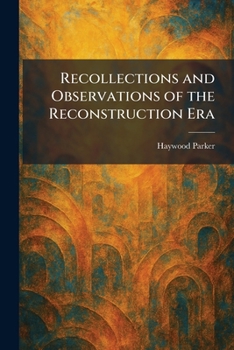
Recollections and Observations of the Reconstruction Era

"Recollections and Observations of the Reconstruction Era" offers a compelling firsthand perspective on one of the most turbulent and transformative periods in American history. Written by Haywood Parker, this work provides a detailed account of the social, political, and economic shifts that followed the conclusion of the American Civil War. Parker explores the complexities of rebuilding the Southern United States, examining the friction between local governance and federal oversight during a time of profound national reorganization.
The narrative delves into the specific challenges faced by communities as they navigated the transition from the old order to a new social reality, highlighting the personal experiences and broader societal impacts of the era. With its focus on historical observation and personal reflection, the book serves as a vital resource for understanding the long-term consequences of Reconstruction on the American landscape. It provides invaluable insights into the tensions of the late 19th century and the evolving identity of the Southern states, making it an essential read for anyone interested in the foundational struggles of the post-war United States.
This work has been selected by scholars as being culturally important, and is part of the knowledge base of civilization as we know it. This work was reproduced from the original artifact, and remains as true to the original work as possible. Therefore, you may see the original copyright references, library stamps (as most of these works have been housed in our most important libraries around the world), and other notations in the work.
This work is in the public domain in the United States of America, and possibly other nations. Within the United States, you may freely copy and distribute this work, as no entity (individual or corporate) has a copyright on the body of the work.
As a reproduction of a historical artifact, this work may contain missing or blurred pages, poor pictures, errant marks, etc. Scholars believe, and we concur, that this work is important enough to be preserved, reproduced, and made generally available to the public. We appreciate your support of the preservation process, and thank you for being an important part of keeping this knowledge alive and relevant.
Customer Reviews
ThriftBooks ® and the ThriftBooks ® logo are registered trademarks of Thrift Books Global, LLC
