


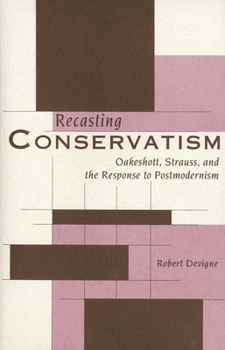
Recasting Conservatism: Oakeshott, Strauss, and the Response to Postmodernism

Select Format
Select Condition 
Book Overview
A new conservative theory in Britain and America has altered the terms of political debate, not only among conservatives, but also among liberals, social democrats, and socialists. In this book, Robert Devigne explores how this conservative thought-in particular the work of the British political philosopher Michael Oakeshott, the American Leo Strauss, and their followers-is responding to the challenge of postmodernism, to the pervasive loss of civil traditions, morality, and authority in contemporary societies. Devigne argues persuasively that new British and American conservative theories are not merely variants of economic liberalism, but also embody a search for new authoritative political and civil relations, each attempting to modify society's future course with outlooks significantly different from those of their conservative predecessors. He shows that while both theories are responding to similar political problematics, their origins in different political philosophies have contributed to distinct constitutional doctrines and political objectives. Devigne explains how these separate outlooks and goals are rooted in different views on morality, authority, democracy, liberty, justice, community, and religion, and in distinct preferences toward economic, social, and foreign policy. Throughout the book, Devigne situates both theories' positions among the central debates of political philosophy and compares each theory to dominant British and American political outlooks of the past.
Format:Paperback
Language:English
ISBN:B000OS6SXG
ISBN13:9780300068689
Release Date:August 1996
Publisher:Yale University Press
Length:284 Pages
Weight:1.00 lbs.
Dimensions:0.9" x 6.0" x 9.2"
Customer Reviews
1 rating
very good book on conservative theory
Published by Thriftbooks.com User , 22 years ago
While I am only a little way into this book, it is very good so far. I know a fair bit about Hayek ond Oakeshott already, but I am learning something new on every page. I am expecting the discussion of Strauss to be good too. The books seems very useful in putting H and O in the context of post WWII theoretical debates in the UK, which it is hard for Americans to get their arms around. Oakeshott is difficult to get through, especially the longer works. A good summary is very useful. The tone of the book is academic and not at all ideologically fired up. It seems the writer may be a student of Richard Flathman, who is a quite distinguished political theorist. The constrasts of Hayek and Oakeshott are also thoughtful and quite useful. Already, I find myself having a clearer view of American neo-cons, who make more sense as a kind of British style conservative rather than anything clearly in the American tradition. The academic writing style is not flashy, but it is very clear. If you're interested in things conservative, visit therightcoast.blogspot.com.
Copyright © 2026 Thriftbooks.com
Terms of Use | Privacy Policy | Do Not Sell/Share My Personal Information | Cookie Notice | Cookie Preferences | Accessibility Statement
ThriftBooks ® and the ThriftBooks ® logo are registered trademarks of Thrift Books Global, LLC
ThriftBooks ® and the ThriftBooks ® logo are registered trademarks of Thrift Books Global, LLC
