


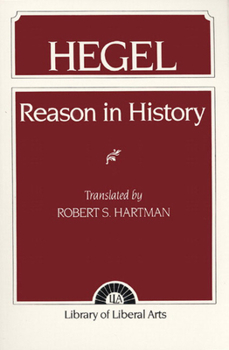
Hegel: Reason in History


Select Format
Select Condition 
Book Overview
Library of Liberal Arts title.
Format:Paperback
Language:English
ISBN:0023513209
ISBN13:9780023513206
Release Date:December 1995
Publisher:Pearson
Length:144 Pages
Weight:0.60 lbs.
Dimensions:0.3" x 5.4" x 7.9"
Customer Reviews
2 ratings
An Introduction to Hegel's Thought
Published by Thriftbooks.com User , 24 years ago
Hegel is considered a notoriously difficult author to understand, and justly so. But his thorny prose is as much a creation of his as his philosophy itself; it was not because he could not write well that he wrote as he did, but because he wrote in such a way as to communicate ideas that did not come easily to language. That said, it is best to start reading Hegel with something like this, rather than the Phenomenology, so as to get an idea of what's at stake in his writings; Hegel's philosophy is essentially recursive, and so the patterns that emerge in one area of his thought are often applicable to others (his ideas on history cross over with his ideas on art which cross over with his ideas on religion, and so on). Thus learning one part of his system helps you to understand other parts. Contrary to one popular prejudice, Hegel's vision isn't just an a priori framework laid down upon empirical facts - although perhaps this does occur at times. Hegel's vision of history was essentially based upon the actual history of the world as he knew it, based upon the wealth of historical sources he had studied (many of which we must now admit to be outdated, particularly his sources for non-Western history). For this reason I recommend this work for two groups in particular: (1) those looking for an entry into the citadel of Hegel and (2) those looking for an interesting interpretation of history. I won't vouch for Hegel's project, but I will vouch for the richness of the ideas expressed here, particularly when Hegel is in his element, writing about Greek and Roman history. The other sections are uneven but those two fascinate.
"Reason in History" is an excellent entry to Hegel's thought
Published by Thriftbooks.com User , 26 years ago
This brief work may be the single best introduction to the philosophy of Hegel in my experience with my college students. The introduction by the translator/editor is a nice synopsis of this area of Hegel's thinking also. Central concepts are the notions of logic in history, the development of the state, and concept of world history. The work is brief and should only be used as introduction.
Copyright © 2026 Thriftbooks.com
Terms of Use | Privacy Policy | Do Not Sell/Share My Personal Information | Cookie Policy | Cookie Preferences | Accessibility Statement
ThriftBooks ® and the ThriftBooks ® logo are registered trademarks of Thrift Books Global, LLC
ThriftBooks ® and the ThriftBooks ® logo are registered trademarks of Thrift Books Global, LLC
