


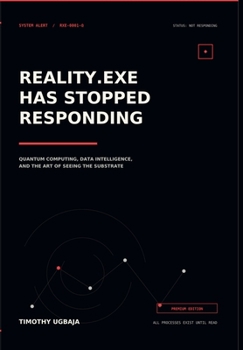
REALITY.EXE Has Stopped Responding: Quantum Computing, Data Intelligence, and the Art of Seeing the Substrate

Every system you have ever been paged about was behaving exactly as designed. That is the problem.
You fixed it in March. You fixed it again in July. The fix held, right up until it didn't. The alerts were green, the dashboard was green, the post-mortem was thorough, the action items were closed - and none of it mattered, because you were debugging the wrong layer.
Underneath the symptom is a substrate. Dependencies. Information flow. Incentives. It has a shape, and that shape is the actual cause of every outage you have ever been called out of bed for. You have been modelling the parts. Nobody taught you to model the thing that decides which part runs, when, in what order, on whose behalf, and at whose expense.
This book teaches you to see it, and then to move it.
Thirty-five chapters, each built around one instrument you can use the same day on the system in front of you: the Boundary Question, the Substrate Model, the Observer Parameter, the Restart Boundary, the Luck Generator. Each carries a Bolded Rule, a drill you can run inside the hour, and a worked failure drawn from the incidents that get closed as "not reproducible" - which were entirely reproducible, and simply were not looked at from the correct depth.
Then the lens turns outward, because it must. The same recursion that explains your outage also explains superposition, entanglement and decoherence, and why quantum parallelism on its own buys you precisely nothing. It explains why a model trained on everything humanity has written will invent a source with total confidence. It explains race conditions between free will and the scheduler, the off switch nobody can find, and the competitive analysis where the competitor is entropy and it has better retention than any feature you will ship.
You will not be asked to think outside the box. There is no box. There is a layer you have been standing on without modelling, and it has been making your decisions for you since the day you started.
Inside: 35 instruments, each with a rule, a drill and a worked failure. 78 symptom routes - "my system does X wrong" - pointing to the chapter that handles it, indexed at the front and the back. 48 error codes the universe has never documented. Seven threads closed as "not reproducible," reopened. A glossary and index built for 2 a.m.
After this book you will not read a system the same way. You will walk into a design review and hear the incentive nobody named. You will look at a flaky test and see the feedback loop that makes it flaky. You will stop fixing the same outage in a new costume every quarter, and reach instead for the handle that was there the whole time - invisible only because you were looking at the components instead of the constraint holding them in shape.
Timothy Ugbaja is Founder and CEO of Tilaverse Inc., with twenty years building mission-critical systems across AI/ML, DevOps and hyperscale cloud.
Customer Reviews
ThriftBooks ® and the ThriftBooks ® logo are registered trademarks of Thrift Books Global, LLC
