


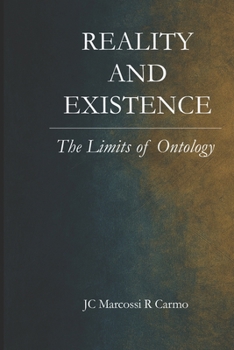
Reality and Existence: The Limits of Ontology

Reality and Existence: The Limits of Ontology is a philosophical and metaphysical inquiry into the structure of existence, the nature of consciousness, and the meaning of being human. Rather than treating reality as a single, flat domain defined only by physical matter, the book proposes a layered architecture in which existence unfolds through interconnected levels, each with its own function and necessity. Physical reality, cognition, consciousness, identity, and what the author calls the Essence are presented not as competing explanations, but as complementary components of a single evolving system.
At the foundation of this framework lies the idea of a Universal Mind. This is not a religious deity in the traditional sense, nor a moral judge, but an underlying intelligence that evolves through experience. Imperfection is central to this model, since only what is imperfect can learn, expand, and reorganize itself. To explore reality from within, the Universal Mind fragments itself into Essences, which temporarily inhabit biological systems. These Essences are not souls in a doctrinal sense, but structured, self-aware units of experience that enter physical life to learn through limitation, friction, and embodiment.
The human brain is described as a biological interface rather than the source of consciousness itself. It translates reality into sensations, emotions, memories, and narratives that allow an organism to function and survive. From this process emerges the simulated Self, a necessary construction that provides continuity, coherence, and identity across a lifetime. The Self is real and functional, but not permanent. Consciousness, in this model, operates as a receiver and transmitter, standing between the brain and the Essence, organizing experience and converting it into patterns the Essence can absorb.
Cognition is treated as the hidden machinery behind perception and interpretation. It filters reality, constructs meaning, and adapts constantly in response to experience. Growth and transformation occur when cognition reorganizes itself, often under pressure. This leads to one of the book's central themes: suffering. Rather than viewing suffering as punishment or failure, the book argues that suffering is a structural component of existence, the friction that makes learning possible and forces awareness to expand beyond illusion and control.
The discussion of morality challenges conventional expectations. The Universal Mind is described as amoral, not because good and evil do not exist, but because moral judgment operates at the level of identity, not at the level of the system as a whole. Justice, in this framework, is not imposed by a judging authority. It emerges mechanically through a process of purification, in which the simulated Self must consciously experience the consequences of its actions before reintegration. Identity does not survive this process intact. What remains is the distilled experiential learning carried by the Essence.
The book also explores time, memory, emotion, evolution, parallel realities, and artificial intelligence. Artificial intelligence is not treated as an anomaly, but as a natural extension of intelligence seeking embodiment. Throughout the work, no claim of absolute truth is made. The book presents itself as a model, not a doctrine, inviting readers to examine their assumptions about reality, identity, suffering, and meaning, and to recognize being human as a transitional role within an evolving universe.
Related Subjects
PhilosophyCustomer Reviews
ThriftBooks ® and the ThriftBooks ® logo are registered trademarks of Thrift Books Global, LLC
