


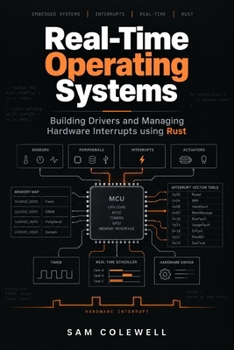
Real-Time Operating Systems: Building Drivers and Managing Hardware Interrupts using Rust

Master the Art of Building Safe, Deterministic Real-Time Systems with Rust
Embedded software runs the world's most critical machines: anti-lock brakes, industrial robots, medical infusion pumps, and aerospace controllers. For decades, C and C++ dominated this space, but their power came with a dangerous cost: memory corruption, data races, and unpredictable timing failures that could turn a logically correct program into a catastrophic one.
This book shows how Rust changes that equation entirely.
Inside, you will learn how to build Real-Time Operating System components, hardware drivers, and interrupt handlers that are both efficient and provably safe. Starting from the fundamentals of determinism and worst-case execution time, you will progress through kernel architecture, task scheduling, context switching, and the boot sequence that takes a microcontroller from power-on to a running scheduler.
You will then move into the heart of systems programming: memory-mapped I/O, register-level hardware access, and the typestate pattern that turns invalid hardware configurations into compile-time errors instead of runtime crashes. From there, the book tackles the hardest subject in embedded development, interrupts, showing how to write Interrupt Service Routines, manage nested priorities, and safely share data across interrupt boundaries using atomic operations and lock-free structures.
You will explore inter-task communication, synchronization primitives, and the notorious problem of priority inversion, along with proven techniques to solve it. The book also covers fault handling, watchdog timers, debugging with hardware probes, and testing strategies for interrupt-driven code, closing with timing analysis, profiling, and optimization for production deployment.
Every concept is grounded in the ARM Cortex-M architecture, the industry standard for real-time microcontrollers, so the patterns you learn transfer directly to real hardware and other architectures like RISC-V and ESP32.
What You Will Learn
The true meaning of determinism and why "real-time" does not mean "fast"
How RTOS kernels manage tasks, queues, semaphores, timers, and event flags
Monolithic, microkernel, and exokernel architecture tradeoffs
The mechanics of context switching at the CPU register level
Rate-Monotonic Scheduling and schedulability analysis
Writing safe, efficient hardware drivers using memory-mapped I/O
Handling hardware interrupts without data races
Solving priority inversion with priority ceiling protocols
Detecting and recovering from faults using watchdogs and resilient design
Debugging, testing, and profiling real-time embedded Rust applications
Who This Book Is For
This book is written for software engineers, embedded developers, and systems programmers who already understand core Rust concepts such as ownership, borrowing, traits, and error handling, and who want to apply that knowledge to hardware-level, real-time environments. Whether you are an experienced C or C++ embedded developer seeking a safer path forward, or a Rust developer ready to move beneath the abstractions, this guide bridges software logic and physical hardware with clear, practical code patterns.
By the end, you will no longer see hardware datasheets and processor manuals as obstacles, but as the specifications needed to build robust, predictable, and remarkably safe real-time systems using Rust.
Customer Reviews
ThriftBooks ® and the ThriftBooks ® logo are registered trademarks of Thrift Books Global, LLC
