


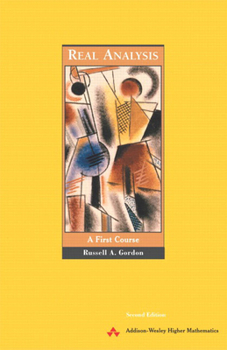
Real Analysis: A First Course

Select Format
Select Condition 
Book Overview
Real Analysis, 2/e is a carefully worded narrative that presents the ideas of elementary real analysis while keeping the perspective of a student in mind. The order and flow of topics has been preserved, but the sections have been reorganized somewhat so that related ideas are grouped together better. A few additional topics have been added; most notably, functions of bounded variation, convex function, numerical methods of integration, and metric spaces. The biggest change is the number of exercises; there are now more than 1600 exercises in the text.
Format:Paperback
Language:English
ISBN:0201437279
ISBN13:9780201437270
Release Date:June 2001
Publisher:Pearson
Length:400 Pages
Weight:1.43 lbs.
Dimensions:0.8" x 6.1" x 9.1"
Customer Reviews
4 ratings
Undergraduate Real Analysis
Published by Thriftbooks.com User , 17 years ago
This book is great text for undergraduate real analysis. It may not be as rigorous as Rudin's but I would recommend it more because being more rigorous doesn't necessarily mean that students will learn more. The book contains both simple and challenging exercises. It is book that can be used as a first course in real analysis. It is both designed mainly for real-line analysis and not multivariate analysis. So, those wanting to see multivariate analysis need to buy another book. One book can't satisfy everyone and that's why there are other books out so that people can choose their flavour. This book is great in my eyes.
Fantastic introduction to analysis
Published by Thriftbooks.com User , 22 years ago
I am using another author's --Strichartz-- garbage text for an analysis course at Cornell. I saw this book at a local B & N near my home, and I immediately saw how superior it was to Strichartz's. This book keeps the beginner of analysis in mind, and the proofs of theorems are sharp and to the point. Plenty of exercises and problems to reinforce the material. The text includes a nice introduction to point-set topology and metric spaces. A++
A great 1-term-undergraduate text in Analysis
Published by Thriftbooks.com User , 27 years ago
This book is a great introduction of the elements of real analysis. However the book chooses some awkward notation at times and skips pertinant depth where needed. My advice is to use as a supplement to a deeper text in analyis such as Maxwell Rosenlicht's, "An introduction to Analyis," Fitzpatrick's, "Advanced Calculus," or the very terse Walter Rudin, "An Introduction to Mathematical Analyis." The book concludes before addressing multivariate analysis and leaves much needed topological aspect to the very end, this is why I recommend the book as a first-term undergraduate text in analyis in conjuction with my recommendation of Rosenlicht's text. Although, altogether very readable.
Real Analysis: A First Course in How to Think
Published by Thriftbooks.com User , 29 years ago
Taking a course in Real Analysis from the author himself (Russell Gordon, Whitman College) is quite an experience, especially when the man's grading style is described as, "Take no prisoners." However, the book, like the author, is excellent and thoroughly challenges the intellect. Essentially a proof of calculus, the work details the majority of the theorems first-year calculus students are told just to accept and not question. After a grueling semester, one should feel confident about pursuing further studies in mathematics, as the text presents these (dare I say) "elementary" concepts in a clear, organized fashion. I only have one quibble: there should be a sticker on the cover that reads, "WARNING: Thinking Required," just in case the title itself didn't clue you in.
Copyright © 2026 Thriftbooks.com Terms of Use
| Privacy Policy | Do Not
Sell/Share My Personal Information | Cookie Policy | Cookie Preferences | Accessibility Statement
ThriftBooks® and the ThriftBooks® logo are registered trademarks of Thrift Books Global, LLC
ThriftBooks® and the ThriftBooks® logo are registered trademarks of Thrift Books Global, LLC
