


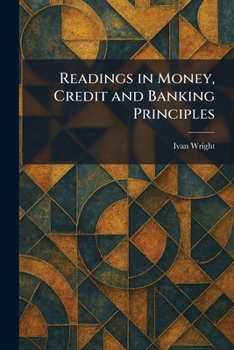
Readings in Money, Credit and Banking Principles

"Readings in Money, Credit and Banking Principles" is an extensive compilation of scholarly writings and primary documents that explore the core functions of the financial world. Assembled to provide a structured overview of monetary systems, the work addresses the essential theories and practices that define money, credit, and the institutional framework of banking.
The volume covers a wide spectrum of topics, including the history and development of currency, the mechanisms of commercial banking, and the structural foundations of credit markets. It offers detailed analyses of the Federal Reserve System, the gold standard, and the factors influencing price fluctuations and economic cycles. By bringing together the insights of prominent economists and financial authorities, the work examines the intricate relationship between banking operations and broader economic stability.
With its focus on both theoretical principles and practical applications, "Readings in Money, Credit and Banking Principles" serves as an important resource for understanding the evolution of financial thought and policy. It provides readers with a rigorous grounding in the economic concepts that shaped the early 20th-century landscape, making it a significant contribution to the study of political economy and financial history.
This work has been selected by scholars as being culturally important, and is part of the knowledge base of civilization as we know it. This work was reproduced from the original artifact, and remains as true to the original work as possible. Therefore, you may see the original copyright references, library stamps (as most of these works have been housed in our most important libraries around the world), and other notations in the work.
This work is in the public domain in the United States of America, and possibly other nations. Within the United States, you may freely copy and distribute this work, as no entity (individual or corporate) has a copyright on the body of the work.
As a reproduction of a historical artifact, this work may contain missing or blurred pages, poor pictures, errant marks, etc. Scholars believe, and we concur, that this work is important enough to be preserved, reproduced, and made generally available to the public. We appreciate your support of the preservation process, and thank you for being an important part of keeping this knowledge alive and relevant.
Customer Reviews
ThriftBooks ® and the ThriftBooks ® logo are registered trademarks of Thrift Books Global, LLC
