


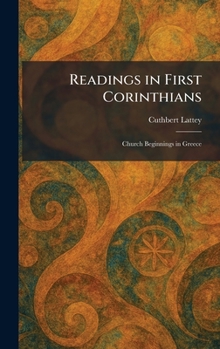
Readings in First Corinthians: Church Beginnings in Greece

"Readings in First Corinthians; Church Beginnings in Greece" offers a detailed scholarly examination of the Apostle Paul's first letter to the Corinthian community, contextualizing the scripture within the historical and cultural landscape of ancient Greece. Authored by the theologian Cuthbert Lattey, this work serves as both a spiritual commentary and a historical study of the nascent Christian church.
The text delves into the pastoral challenges faced by Paul as he addressed the moral, social, and liturgical issues within the diverse and often tumultuous city of Corinth. By blending rigorous exegesis with insights into the Greco-Roman world, the author provides readers with a deeper understanding of the theological foundations laid during these formative years. Topics covered include the nature of Christian unity, the role of spiritual gifts, and the early development of ecclesiastical authority. This volume remains a valuable resource for students of the New Testament, offering a clear and insightful perspective on one of the most significant correspondences in the biblical canon.
This work has been selected by scholars as being culturally important, and is part of the knowledge base of civilization as we know it. This work was reproduced from the original artifact, and remains as true to the original work as possible. Therefore, you may see the original copyright references, library stamps (as most of these works have been housed in our most important libraries around the world), and other notations in the work.
This work is in the public domain in the United States of America, and possibly other nations. Within the United States, you may freely copy and distribute this work, as no entity (individual or corporate) has a copyright on the body of the work.
As a reproduction of a historical artifact, this work may contain missing or blurred pages, poor pictures, errant marks, etc. Scholars believe, and we concur, that this work is important enough to be preserved, reproduced, and made generally available to the public. We appreciate your support of the preservation process, and thank you for being an important part of keeping this knowledge alive and relevant.
Customer Reviews
ThriftBooks ® and the ThriftBooks ® logo are registered trademarks of Thrift Books Global, LLC
