


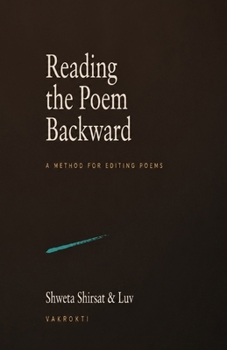
Reading the Poem Backward: A Method for Editing Poems

There are hundreds of books that teach you to write a poem. This one starts where they stop.
You have a draft. Something is wrong with it. You can feel it and you cannot name it, and so you begin improving lines, and the poem gets smoother and deader with every pass.
The problem is that you are editing before you know what the poem is running on.
Reading the Poem Backward is a working method for editing poems, built during the editing of twenty poems and mostly discovered by getting it wrong. It runs the writing process in reverse to recover a poem's engine, then subtracts everything fighting it, then restores what should never have been cut.
What is in itThree passes. Reverse, Subtract, Restore. Diagnose before you touch a line.Seven questions that recover what a poem is actually doing, and the characteristic way each one goes wrong.A taxonomy of fifteen faults - the elaboration leak, the narrated turn, the beautiful runway, the consoling ending, the calque spine, the self-admiring line - each one named, diagnosable, and shown in a real draft.Three unedited sessions, including two where the editor was wrong and the poet caught it.Rules of engagement for the conversation between a writer and an editor, which is where poems actually get better.A chapter on editing across two languages, for the small number of writers who can be wrong in both.Every draft quoted is a real draft. The failures are left in.
The central claim: a broken poem is almost never missing something. It is carrying something, and it is heavy.
And a warning, which the book makes against itself: remove all fifteen faults and you will have a poem with nothing wrong with it, and nothing wrong with it is a description of a corpse.
For poets with drafts they cannot fix. For editors who want a vocabulary instead of an opinion. For anyone who has been told a poem "isn't working" and given nothing to do about it.
Customer Reviews
ThriftBooks ® and the ThriftBooks ® logo are registered trademarks of Thrift Books Global, LLC
