


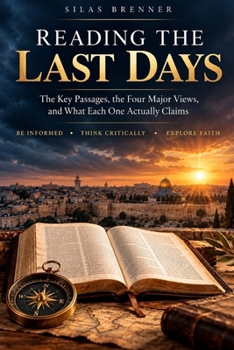
Reading the Last Days: The Key Passages, the Four Major Views, and What Each One Actually Claims

Three sermons on the end times. Three different answers. And no way to tell who was right.
If that is where you are, you are not missing something everyone else was given. There is no key. There are texts, there are ways of reading them, and the disagreement you noticed is real, ancient, and held by serious people on every side.
This book is about those texts and those readings.
It does not tell you when. Not a year, not a decade, not a generation. Every date set in nineteen centuries has been wrong, and Chapter 11 explains why the method itself cannot work.
It does not name anyone. No political figure is identified as the Antichrist. Books that do this are quietly withdrawn when the person dies in bed.
It does not tell you which side is right. On the millennium, the rapture, and Israel and the church, you get the strongest form of each position and an honest statement that the book is not deciding for you.
What you get instead: The passages themselves - Daniel 2, 7, 9 and 11-12; Ezekiel; Joel; Zechariah; Matthew 24-25 with Mark and Luke; 1 and 2 Thessalonians; 1 Corinthians 15; and Revelation, quoted in contextThe vocabulary, defined - parousia, tribulation, millennium, rapture, preterist, historicist, futurist, idealist, amillennial, postmillennial, dispensation. Most confusion in this subject is people using one word for different thingsFour ways to read Revelation, applied to the same eight passages so you can see exactly where they divergeFour positions on the millennium, each argued in the form its own holders would acceptThe rapture debate - all four timings, the case for each, and the documented history of where the pretribulational view came fromDeath, judgement and the new creation - the individual questions most books on this subject skipHow the church has read this, century by century, from Irenaeus to the Scofield BibleA field guide to prophecy claims - six questions to ask of anything you read or hearSix diagrams that put the positions side by side - the millennium, the rapture, the seventy weeks, and the shape of RevelationThirty-four discussion questions for personal study or a group working through a chapter a weekEvery claim about what the Bible says carries its chapter and verse in the text, where you can check it. Scripture is quoted from the King James Version.
One promise. This book will not make you certain. What it offers is the ability to read the texts yourself, to recognise an argument when you meet one, and to tell the difference between what the Bible says and what someone has built on top of it.
On a subject where confident voices have been wrong for nineteen centuries running, that is worth more than another confident voice.
This book presents the major Christian interpretations of biblical prophecy and does not advocate one of them. It is not affiliated with, endorsed by, or produced on behalf of any denomination, church body or ministry.
Scroll up, download it now, and start with Chapter 1.
Customer Reviews
ThriftBooks ® and the ThriftBooks ® logo are registered trademarks of Thrift Books Global, LLC
