


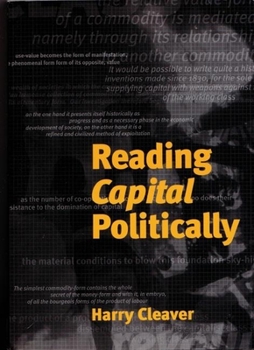
Reading Capital Politically


Select Format
Select Condition 
Book Overview
As social movements waned in the late 70s, the study of Marx seemed to take on a life of its own. Structuralist, post-structuralist, deconstructed Marxes bloomed in journals and seminar rooms across the US and Europe. These Marxes and their interpreters struggled to interpret the world, and sometimes to interpret Marx himself, losing sight at times of his dictum that the challenge is not to interpret the world but to change it. In 1979, Harry Cleaver tossed an incendiary device called Reading Capital Politically into those seminar rooms. Through a close reading of the first chapter, he shows that Das Kapital was written for the workers, not for academics, and that we need to expand our idea of workers to include housewives, students, the unemployed, and other non-waged workers. Reading Capital Politically provides a theoretical and historical bridge between struggles in Europe in the 60s and 70s and, particularly, the Autonomia of Italy to the Zapatistas of the 90s. His introduction provides a brilliant and succinct overview of working class struggles in the century since Capital was published. Cleaver adds a new preface to the AK Press/Anti-Thesis edition.
Format:Paperback
Language:English
ISBN:1902593294
ISBN13:9781902593296
Release Date:January 2000
Publisher:Antithesis
Length:184 Pages
Weight:0.20 lbs.
Dimensions:0.5" x 4.7" x 6.8"
Customer Reviews
5 ratings
An insightful analysis of the international class struggle!
Published by Thriftbooks.com User , 19 years ago
In this classic book on autonomous Marxism, Harry Cleaver extends the definition of the proletariat to include marginalized economic and political actors like students, housewives, and the unemployed. In this era of corporate globalization, imperialist war, and political repression, Cleaver's book is more important than ever. Global justice activists interested in Zapatismo and the political theories advanced by the recent social movements in Argentina will especially enjoy Cleaver's exciting interpretation of Marxism. Rather than advocating the old left notion of vanguard parties and state bureaucracies, Cleaver, like Michael Albert, argues in favor of direct democracy, decentralization, and participatory economics. For activists engaged in workplace organizing, protests against the G8 or WTO, and civil rights advocacy on behalf of immigrants, low-income tenants, and other oppressed communities, this is definitely a worthwhile read.
Fine political reading of Capital's elements
Published by Thriftbooks.com User , 20 years ago
Harry Cleaver in this, by now classic, book analyzes the core of Capital's analysis of capitalism from the perspective of better understanding the class struggle. In so doing, he strongly agitates against the 'political economy reading' of Marx, which sees his analysis as mainly an abstract mechanistic one, ignoring the role of the class struggle in the position of capital. As reviewer Byars has pointed out, this criticism fails because it is not the political economy reading but Capital itself that is one-sided: Marx intended to focus only on capitalism from the perspective of capital itself in this book, and there are indications he wanted to deal with the rest later. As we all know, he unfortunately died before being able to do this. Cleaver further repeats the by now ancient meme about Marx having the full, 'humanist' etc. understanding of things but the evil Engels giving a false impression of his works, so creating Marxism and all its Party orthodoxies. This was ridiculous nonsense then and it remains so now, and there are far too many otherwise competent Marxist authors repeating this. It's disappointing to see Cleaver is one of them. Cleaver's explanation of the meaning of value, abstract labor and the qualitative as well as quantitative aspects of commodities in capitalism is excellent. The general level of the book is hardly easier to read than Capital itself, but is far shorter, which alone makes it worthwhile. His exposition on the mediating role of money is also good, but a bit too short and vague. This also goes for Cleaver's handling of the relation between value and price, which ignores issues with the so-called 'transformation problem' entirely. Because of this, I give the work an overall four stars. It's certainly recommended for a clear, sharp understanding of the role the class struggle plays in Capital itself, as well as for a reasonable, though at times too succinct explanation of some basic terms like value and abstract labor. However, Cleaver's introduction, in which he sets out the work's relation to other Marxist works, is pompous and wrong. So stick to reading his main argumentation and ignore the rest.
excellent book
Published by Thriftbooks.com User , 23 years ago
Cleaver restores the communist tradition looking back to Capital to understand class struggle, and NOT the vanguard party, as the motivator of communism. Cleaver re-examines Capital with an understanding that is popularly overlooked by the Soviet fetishists: the composition of labor and capital. Cleaver sews in his understand of the often willfully ignored communist left from Rosa Luxemburg, to CLR James, to even the Italian Autonomia Operaia. His understand of Capital is only the beginning though. To really get a grip on where he's coming from I suggest also checking out Werner Bonefeld's Revolutionary Writing, a compilation which Cleaver is also in. Cleaver's interpretation of Capital is most that of the composition of the working class and does not fully extend (at least not directly) to that of the social factory, social labor, contemporary alienation, the refusal of work, and many of the other theories of autonomist Marxists.The communist left have an elaborate history that most in the mainstream, both capitalist and vanguard communist, would like to ignore for the benefit of a dualistic thinking. This is possibly the best summation of Autonomist communism available....
The Struggle Continues
Published by Thriftbooks.com User , 24 years ago
Now that the Soviet Union is gone, should Marx exit too? Before you dig that grave, check out working conditions world wide, from underage Asian sweatshops to desperate whitecollar temps to idled American steel workers. The Soviet Union may be gone, but by all evidence the class struggle of epic lore continues. Obituaries to the contrary, Cleaver maintains Marxism is still very much alive, and most importantly, able to furnish strategies for defeating the reign of wage slavery. But first we have to stop reading Capital as though it's just economics. That has only brought us tyrannical communist parties, feckless parliamentary reformers, and ivory tower Kultur critics. The book's first half traces this misdirected path over the past century. The second half walks us through Capital's Chapter One with different spectacles on -- what Cleaver calls a "political reading". This fresh approach, Cleaver believes, reveals a political dimension long hidden by the old economist prism, and one that is capable of turning Capital's overlooked human potential into effective worker strategizing against wage slavery. How much of this is on target. Well, I wish Cleaver had updated this second edition from the 1970's to the 90's, because the 70's were a very different landscape from now. Capital has since morphed and gone on a rampage, replacing its crisis of the 70's with a worker's crisis of the new millenium. Too bad Cleaver's of little help in analyzing recent developments despite many nuggets along the way. Nonetheless, there remains the intellectual side. Cleaver certainly wants to bring back the human element, which is well and good, given the doubts cast upon structuralism and its exclusion of the subjective. But are working people the only uncontrollable card in the capitalist deck, as Cleaver asserts. What with lotteries, tv, and wall to wall news management, I begin to wonder. Still there's the book's main point: what about a political reading, new spectacles, and Capital-led strategizing. Aside from a few angles on use-value and exchange-value, and a really sparkling section on money and value, I'm not sure how much actual help a political reading is. But then I've always been a little myopic, so maybe he's owed the benefit. Three things I do know. As long as there is capital, there will be hungry workers, class struggle, and Karl Marx; and also that-- despite the superficial dismissal by reviewer Allen-- Cleaver's work remains an important contribution to the CLR James school of activism, and should be judged on its own merits.
The real Marx
Published by Thriftbooks.com User , 26 years ago
Read this book if you are interested in Marx's 'Capital' as a weapon in the working class' war with Capital. If you are a Leninist or other wannabe future ruler you will be infuriated.
Copyright © 2026 Thriftbooks.com
Terms of Use | Privacy Policy | Do Not Sell/Share My Personal Information | Cookie Notice | Cookie Preferences | Accessibility Statement
ThriftBooks ® and the ThriftBooks ® logo are registered trademarks of Thrift Books Global, LLC
ThriftBooks ® and the ThriftBooks ® logo are registered trademarks of Thrift Books Global, LLC
