


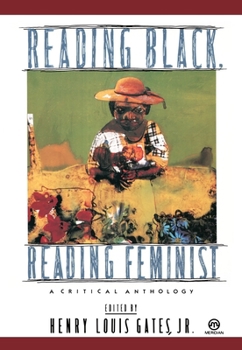
Reading Black, Reading Feminist: A Critical Anthology

A unique and comprehensive collection of 26 literary essays that explore the rich cultural history of black women in America. Black women's writing has finally emerged as one of the most dynamic fields of American literature. Here, leading literary critics--both male and female, black and white--look at fiction, nonfiction, poetry, slave narratives, and autobiographies in a totally new way. In essence, they reconstruct a literary history that documents black women as artists, intellectuals, symbol makers, teachers, and survivors. Important writers whose work and lives are explored include Toni Morrison, Gloria Gaynor, Maya Angelou, and Alice Walker, and the fascinating list of essays range from Nellie Y. McKay's "The Souls of Black Women Folk in the Writings of W. E. B. Du Bois" to Jewelle L Gomez's very personal tribute to Lorraine Hansberry as a dramatist and crusader for social justice. Henry Louis Gates Jr., the editor of this anthology and a noted authority on African-American literature, has provided a thought-provoking introduction that celebrates the experience of "reading black, reading feminist." A penetrating look at women's writing from a unique perspective, this superb collection brings to light the rich heritage of literary creativity among African-American women. "Why is the fugitive slave, the fiery orator, the political activist, the abolitionist always represented as a black man? How does the heroic voice and heroic image of the black woman get suppressed in a culture that depended on her heroism for survival?"--Mary Helen Washington, from her essay in Reading Black, Reading Feminist
Format:Paperback
Language:English
ISBN:0452010454
ISBN13:9780452010451
Release Date:October 1990
Publisher:Penguin Publishing Group
Length:544 Pages
Weight:1.60 lbs.
Dimensions:1.2" x 5.9" x 9.0"
Customer Reviews
1 rating
Awesome text for womanist readers! (bell was wrong, btw)
Published by Thriftbooks.com User , 24 years ago
I didn't read all of this book, but I know it's a winner. Female readers should not be threatened by the introduction being written by Gates, a man. He has consistently supported work by women and gay men and shown himself to be quite the cool straight man. In this book, many academics analyze well-known texts by black women. You'll be relieved that it's critical, and not gushy or essentialist. Here's my one big problem. In her discussion of Walker's "The Color Purple", hook condemns Walker for turning Celie into a capitalist after all the racist, sexist, and classist (and possibly homophobic) exploitation she faced throughout her life. However, what hooks fails to realize is that Celie created a business called "Folks Pants" that made clothes fit for both genders and all sizes. The "folk" in the title has very socialist implications. hooks should be pleased that Celie finally has some agency and can live by her own means and on her own terms. Methinks hooks is jealous of Walker's success.
Copyright © 2026 Thriftbooks.com
Terms of Use | Privacy Policy | Do Not Sell/Share My Personal Information | Cookie Policy | Cookie Preferences | Accessibility Statement
ThriftBooks ® and the ThriftBooks ® logo are registered trademarks of Thrift Books Global, LLC
ThriftBooks ® and the ThriftBooks ® logo are registered trademarks of Thrift Books Global, LLC
