


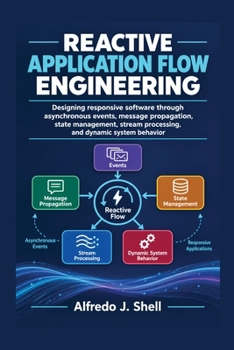
REACTIVE APPLICATION FLOW ENGINEERING: Designing responsive software through asynchronous events, message propagation, state management, stream processing, and dynamic system behavior
No Customer Reviews

REACTIVE APPLICATION FLOW ENGINEERING provides a detailed exploration of how modern software systems can be designed to respond to events, process information asynchronously, manage changing state, and coordinate dynamic application behavior. Rather than treating an application as a sequence of isolated operations, the book examines software as a continuously changing flow of events, messages, data, and state transitions. The book introduces the engineering principles behind reactive application flows and explains how asynchronous events can move through interconnected software components. It examines event producers, consumers, message channels, processing stages, state stores, and response mechanisms, showing how these elements can be organized into systems that respond to changing inputs without relying entirely on synchronous execution. Particular attention is given to state management and event propagation. Applications often need to maintain information while responding to multiple events occurring at different times. Understanding how state changes, how events are ordered or correlated, and how components react to those changes is therefore central to building predictable reactive systems. The book explores approaches for coordinating state transitions, handling concurrent events, and maintaining consistency across distributed application components. Key topics include: * Reactive application architecture
* Asynchronous event processing
* Event-driven software design
* Message propagation and routing
* Stream processing architectures
* Application state management
* State transitions and event correlation
* Event producers and consumers
* Message queues and communication channels
* Backpressure and flow control
* Concurrent event processing
* Error handling and recovery strategies
* Distributed state coordination
* Event ordering and delivery considerations
* Data streams and transformation pipelines
* Real-time application behavior
* Reactive service communication
* System monitoring and observability
* Testing asynchronous application flows
* Scalability and workload management
* Fault tolerance and resilience
* Dynamic system behavior The book also considers the relationship between reactive flows and broader software architecture. Topics such as modularity, service boundaries, asynchronous communication, data transformation, system coordination, and failure handling are examined from the perspective of applications that must continuously respond to changing conditions. REACTIVE APPLICATION FLOW ENGINEERING is intended for software developers, application architects, systems engineers, computer science students, and technical professionals interested in event-driven and asynchronous software systems. It provides a structured foundation for understanding how events, messages, state, streams, and processing components can work together to create responsive and adaptable applications. Build a stronger understanding of reactive software systems. Explore the principles of asynchronous flow, event propagation, state management, and stream processing, and develop the engineering perspective needed to design applications that can respond effectively to continuous change.
* Asynchronous event processing
* Event-driven software design
* Message propagation and routing
* Stream processing architectures
* Application state management
* State transitions and event correlation
* Event producers and consumers
* Message queues and communication channels
* Backpressure and flow control
* Concurrent event processing
* Error handling and recovery strategies
* Distributed state coordination
* Event ordering and delivery considerations
* Data streams and transformation pipelines
* Real-time application behavior
* Reactive service communication
* System monitoring and observability
* Testing asynchronous application flows
* Scalability and workload management
* Fault tolerance and resilience
* Dynamic system behavior The book also considers the relationship between reactive flows and broader software architecture. Topics such as modularity, service boundaries, asynchronous communication, data transformation, system coordination, and failure handling are examined from the perspective of applications that must continuously respond to changing conditions. REACTIVE APPLICATION FLOW ENGINEERING is intended for software developers, application architects, systems engineers, computer science students, and technical professionals interested in event-driven and asynchronous software systems. It provides a structured foundation for understanding how events, messages, state, streams, and processing components can work together to create responsive and adaptable applications. Build a stronger understanding of reactive software systems. Explore the principles of asynchronous flow, event propagation, state management, and stream processing, and develop the engineering perspective needed to design applications that can respond effectively to continuous change.
Format:Paperback
Language:English
ISBN:B0HKLTQ3TJ
ISBN13:9798175633734
Release Date:September 2026
Publisher:Independently published
Length:260 Pages
Weight:0.78 lbs.
Dimensions:9.0" x 0.6" x 6.0"
Customer Reviews
0 rating
Copyright © 2026 Thriftbooks.com
Terms of Use | Privacy Policy | Do Not Sell/Share My Personal Information | Cookie Notice | Cookie Preferences | Accessibility Statement
ThriftBooks ® and the ThriftBooks ® logo are registered trademarks of Thrift Books Global, LLC
ThriftBooks ® and the ThriftBooks ® logo are registered trademarks of Thrift Books Global, LLC
