


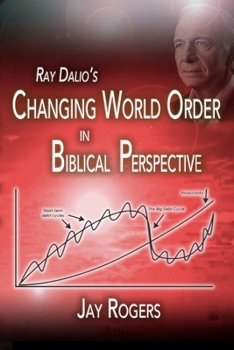
Ray Dalio's Changing World Order: Book 1 of the Changing World Order series

Ray Dalio's Changing World Order - Book 1 of the Changing World Order series, analyzes and critiques the economic theories of Ray Dalio. Rogers' work interprets Dalio's "Big Cycle" of empire decline through a biblical worldview, exploring geopolitical shifts and the future of liberty.
Key details regarding Jay Rogers' analysis of Ray Dalio: Themed Analysis: Rogers explores how Dalio's economic principles - such as debt cycles and the decline of empires-align with or challenge a Christian worldview.Content: The book explores the Big Cycle of rising and falling empires, focusing on how wealth gaps, debt, and political shifts in the U.S. mirror past empires.Perspective: Unlike purely economic analyses, Rogers frames these changes as a 500-year tectonic shift in global power, offering a "field manual" for navigating the 21st century.Focus: The work aims to bridge the gap between Dalio's secular, historical analysis of power and a theological perspective on the "hope of Christian Liberty."
The world is fracturing. The old order is crumbling, and the future is a battleground of ideas. While most of us watch the headlines in confusion, a handful of brave thinkers - Ray Dalio, Samuel Huntington, and Aleksandr Dugin - saw it coming decades ago. For their prophetic insights, they have been shunned, banned, and even targeted.
But what if they are right?
This book series does not merely summarize their powerful theories on the new multipolar world. It confronts them, critiques them, and forges them into a new vision - a Christian American response to the greatest geopolitical shift of our time. This is more than an analysis; it's a field manual for understanding the chaos and championing the story of Liberty in the 21st century. We are living through a tectonic shift in global power - a change so profound we haven't seen its like in 500 years.
The Changing World Order Book Series
1. Ray Dalio's Changing World Order provides an economic analysis, tracing the "Big Cycle" of rising and falling empires. He argues this cycle has led to an imminent historical inflection point, driven by the interplay of smaller economic trends.
2. Samuel P. Huntington's Clash of Civilizations advances a theory of a multipolar world order based on deep cultural civilizations, not political ideologies. His political and sociological framework first proposed in the late 1980s explains the global shifts we are witnessing decades later.
3. Aleksandr Dugin's Fourth Political Theory offers a philosophical and spiritual perspective. As a Russian Orthodox Christian, Dugin presents the most anti-Modernist and controversial view, challenging us to reconsider what it means to be human in a world opposed to tradition and spirituality.
Customer Reviews
ThriftBooks® and the ThriftBooks® logo are registered trademarks of Thrift Books Global, LLC
