


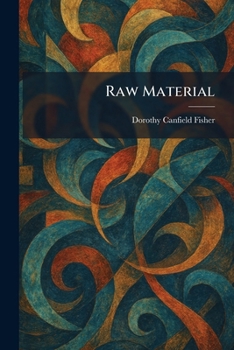
Raw Material

Select Format
Select Condition 
Book Overview
"Raw Material" is a compelling collection of character studies and narrative sketches by the celebrated American author Dorothy Canfield Fisher. Departing from the structure of a traditional novel, this work presents the vivid, unrefined ingredients of human experience-the "raw material" from which great literature is forged. Through a series of insightful vignettes, Fisher captures the essence of diverse personalities and the subtle complexities of social interaction, often set against the backdrop of small-town life and the shifting landscapes of early 20th-century society.
Each portrait serves as a masterclass in observation, revealing the profound depth found in seemingly ordinary lives. Fisher explores themes of morality, resilience, and the hidden motivations that drive human behavior. By stripping away the elaborate plotting of a standard work of fiction, she invites the reader to engage directly with the psychological truth and atmospheric detail of her subjects. "Raw Material" stands as a significant contribution to American literary realism, showcasing Fisher's keen eye for detail and her enduring empathy for the human condition.
This work has been selected by scholars as being culturally important, and is part of the knowledge base of civilization as we know it. This work was reproduced from the original artifact, and remains as true to the original work as possible. Therefore, you may see the original copyright references, library stamps (as most of these works have been housed in our most important libraries around the world), and other notations in the work.
This work is in the public domain in the United States of America, and possibly other nations. Within the United States, you may freely copy and distribute this work, as no entity (individual or corporate) has a copyright on the body of the work.
As a reproduction of a historical artifact, this work may contain missing or blurred pages, poor pictures, errant marks, etc. Scholars believe, and we concur, that this work is important enough to be preserved, reproduced, and made generally available to the public. We appreciate your support of the preservation process, and thank you for being an important part of keeping this knowledge alive and relevant.
Customer Reviews
ThriftBooks® and the ThriftBooks® logo are registered trademarks of Thrift Books Global, LLC
