


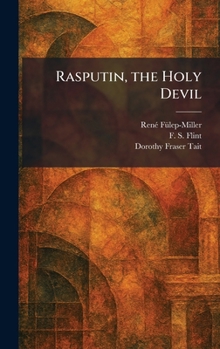
Rasputin, the Holy Devil

"Rasputin, the Holy Devil" is a compelling biographical study of Grigori Rasputin, one of the most enigmatic and controversial figures in modern history. This work delves deep into the life of the Siberian peasant who rose from obscurity to become the spiritual advisor to the Romanov family during the final years of the Russian Empire. The narrative explores the complex duality of Rasputin's persona-a man viewed by some as a saintly healer and by others as a manipulative debauchee whose influence accelerated the fall of the Tsarist regime.
Through vivid storytelling, the book examines Rasputin's mystical practices, his extraordinary physical presence, and the hypnotic hold he maintained over Empress Alexandra. It also provides a sweeping look at the social and political decay of early 20th-century Russia, setting the stage for the Bolshevik Revolution. This classic biography remains an essential resource for those interested in the intersection of religion, power, and the tragic end of the Russian monarchy. Readers will find a fascinating portrait of a man who embodied the chaotic spirit of a nation on the brink of collapse.
This work has been selected by scholars as being culturally important, and is part of the knowledge base of civilization as we know it. This work was reproduced from the original artifact, and remains as true to the original work as possible. Therefore, you may see the original copyright references, library stamps (as most of these works have been housed in our most important libraries around the world), and other notations in the work.
This work is in the public domain in the United States of America, and possibly other nations. Within the United States, you may freely copy and distribute this work, as no entity (individual or corporate) has a copyright on the body of the work.
As a reproduction of a historical artifact, this work may contain missing or blurred pages, poor pictures, errant marks, etc. Scholars believe, and we concur, that this work is important enough to be preserved, reproduced, and made generally available to the public. We appreciate your support of the preservation process, and thank you for being an important part of keeping this knowledge alive and relevant.
Customer Reviews
ThriftBooks ® and the ThriftBooks ® logo are registered trademarks of Thrift Books Global, LLC
