


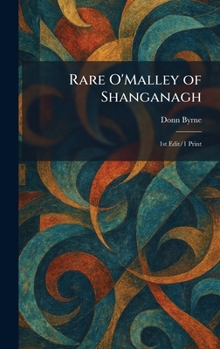
Rare O'Malley of Shanganagh: 1st Edit/1 Print

"O'Malley of Shanganagh" is a poignant and evocative novel by the celebrated Irish-American author Donn Byrne. Set against the lush and lyrical backdrop of early 20th-century Ireland, the story follows the life of de Bourke O'Malley, a man whose destiny is irrevocably altered by a chance encounter and a profound, yet forbidden, love. The narrative masterfully blends themes of passion, spiritual conflict, and the haunting beauty of the Irish landscape.
As O'Malley falls deeply in love with a young woman who has committed her life to the church, the novel explores the tensions between earthly desire and religious devotion. Byrne's prose is noted for its rhythmic, almost musical quality, capturing the soul of Ireland and the melancholy of unfulfilled longing. This work stands as a testament to Byrne's ability to weave romantic idealism with a tragic sensibility, making it a compelling read for those interested in classic Irish fiction and timeless tales of the heart.
Readers will find in "O'Malley of Shanganagh" a rich tapestry of emotion and atmosphere, illustrating why Donn Byrne was one of the most popular storytellers of his era. It remains a significant contribution to the literary tradition of the Irish Renaissance, offering a glimpse into a world of chivalry, sorrow, and the enduring power of memory.
This work has been selected by scholars as being culturally important, and is part of the knowledge base of civilization as we know it. This work was reproduced from the original artifact, and remains as true to the original work as possible. Therefore, you may see the original copyright references, library stamps (as most of these works have been housed in our most important libraries around the world), and other notations in the work.
This work is in the public domain in the United States of America, and possibly other nations. Within the United States, you may freely copy and distribute this work, as no entity (individual or corporate) has a copyright on the body of the work.
As a reproduction of a historical artifact, this work may contain missing or blurred pages, poor pictures, errant marks, etc. Scholars believe, and we concur, that this work is important enough to be preserved, reproduced, and made generally available to the public. We appreciate your support of the preservation process, and thank you for being an important part of keeping this knowledge alive and relevant.
Customer Reviews
ThriftBooks ® and the ThriftBooks ® logo are registered trademarks of Thrift Books Global, LLC
