


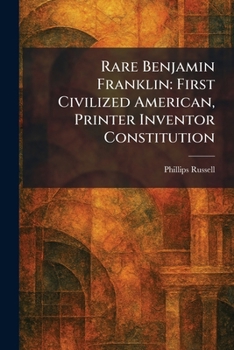
Rare Benjamin Franklin: First Civilized American, Printer Inventor Constitution

Select Format
Select Condition 
Book Overview
"Benjamin Franklin: First Civilized American" is a compelling and insightful biography that explores the multifaceted life of one of America's most iconic Founding Fathers. Written by Phillips Russell, this work delves into the extraordinary career of Benjamin Franklin, portraying him not just as a statesman, but as a true polymath whose influence spanned printing, science, and international diplomacy. The narrative follows Franklin's journey from a humble apprentice printer in Boston to a world-renowned inventor and a pivotal figure in the drafting of the United States Constitution.
Through a detailed examination of his personal and professional life, the book highlights Franklin's contributions to the American Enlightenment, his scientific breakthroughs with electricity, and his crucial role in securing French support during the American Revolution. Russell presents Franklin as a figure of wit and wisdom, embodying the spirit of a burgeoning nation. This biography offers a comprehensive look at the "First Civilized American," capturing the essence of a man whose legacy continues to shape the political and cultural landscape of the United States. It is an essential read for those interested in the history of the Revolutionary era and the life of a man who was truly ahead of his time.
This work has been selected by scholars as being culturally important, and is part of the knowledge base of civilization as we know it. This work was reproduced from the original artifact, and remains as true to the original work as possible. Therefore, you may see the original copyright references, library stamps (as most of these works have been housed in our most important libraries around the world), and other notations in the work.
This work is in the public domain in the United States of America, and possibly other nations. Within the United States, you may freely copy and distribute this work, as no entity (individual or corporate) has a copyright on the body of the work.
As a reproduction of a historical artifact, this work may contain missing or blurred pages, poor pictures, errant marks, etc. Scholars believe, and we concur, that this work is important enough to be preserved, reproduced, and made generally available to the public. We appreciate your support of the preservation process, and thank you for being an important part of keeping this knowledge alive and relevant.
Customer Reviews
ThriftBooks ® and the ThriftBooks ® logo are registered trademarks of Thrift Books Global, LLC
