


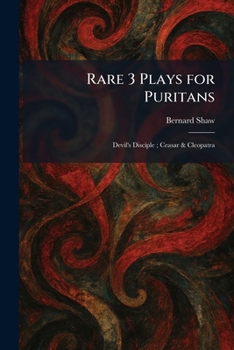
Rare 3 Plays for Puritans: Devil's Disciple; Ceasar & Cleopatra

"Three Plays for Puritans" is a landmark collection of dramatic works by the celebrated Nobel laureate George Bernard Shaw. This volume brings together three of his most influential plays: "The Devil's Disciple," "Caesar and Cleopatra," and "Captain Brassbound's Conversion." Written at the turn of the 20th century, these works represent Shaw's deliberate attempt to challenge the conventional melodrama of late Victorian theatre by replacing sentimentality with intellectual rigor and sharp social critique.
In "The Devil's Disciple," Shaw subverts the traditional war drama with a story set during the American Revolution, exploring themes of martyrdom and moral integrity. "Caesar and Cleopatra" offers a brilliant reimagining of Roman history, presenting a complex, pragmatic Julius Caesar who mentors a young, emerging Queen of Egypt. Finally, "Captain Brassbound's Conversion" serves as a witty exploration of justice, revenge, and the complexities of colonial encounters.
Accompanied by Shaw's characteristically insightful prefaces, these plays showcase his mastery of dialogue and his commitment to the drama of ideas. This collection remains essential reading for students of modern drama and admirers of Shaw's enduring wit and satirical genius.
This work has been selected by scholars as being culturally important, and is part of the knowledge base of civilization as we know it. This work was reproduced from the original artifact, and remains as true to the original work as possible. Therefore, you may see the original copyright references, library stamps (as most of these works have been housed in our most important libraries around the world), and other notations in the work.
This work is in the public domain in the United States of America, and possibly other nations. Within the United States, you may freely copy and distribute this work, as no entity (individual or corporate) has a copyright on the body of the work.
As a reproduction of a historical artifact, this work may contain missing or blurred pages, poor pictures, errant marks, etc. Scholars believe, and we concur, that this work is important enough to be preserved, reproduced, and made generally available to the public. We appreciate your support of the preservation process, and thank you for being an important part of keeping this knowledge alive and relevant.
Related Subjects
DramaCustomer Reviews
ThriftBooks® and the ThriftBooks® logo are registered trademarks of Thrift Books Global, LLC
