


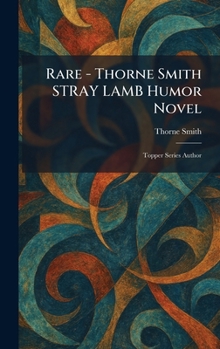
Rare - Thorne Smith STRAY LAMB Humor Novel: Topper Series Author

"The Stray Lamb" is a whimsical and irreverent work of classic humor by Thorne Smith, the celebrated author known for the "Topper" series. This satirical novel follows the unexpected adventures of T. Lawrence Lamb, a conventional and somewhat repressed businessman whose life is turned upside down when he begins to undergo a series of bizarre physical transformations. Without warning, Lamb finds himself shifting from human form into various animals-including a seagull, a stallion, and a kangaroo-leading to a sequence of chaotic and hilarious encounters with high society.
Smith's narrative is a masterclass in early urban fantasy and sophisticated slapstick, poking fun at the rigid social mores and domestic expectations of the early 20th century. As Lamb navigates his involuntary metamorphosis, the story explores themes of identity, liberation, and the absurdity of modern life. Known for its sparkling dialogue and imaginative premise, "The Stray Lamb" remains a standout example of Smith's unique brand of ribald comedy and fantastical storytelling. Readers will enjoy the playful spirit and surreal wit that established Thorne Smith as one of the most popular humorists of his era.
This work has been selected by scholars as being culturally important, and is part of the knowledge base of civilization as we know it. This work was reproduced from the original artifact, and remains as true to the original work as possible. Therefore, you may see the original copyright references, library stamps (as most of these works have been housed in our most important libraries around the world), and other notations in the work.
This work is in the public domain in the United States of America, and possibly other nations. Within the United States, you may freely copy and distribute this work, as no entity (individual or corporate) has a copyright on the body of the work.
As a reproduction of a historical artifact, this work may contain missing or blurred pages, poor pictures, errant marks, etc. Scholars believe, and we concur, that this work is important enough to be preserved, reproduced, and made generally available to the public. We appreciate your support of the preservation process, and thank you for being an important part of keeping this knowledge alive and relevant.
Customer Reviews
ThriftBooks ® and the ThriftBooks ® logo are registered trademarks of Thrift Books Global, LLC
