


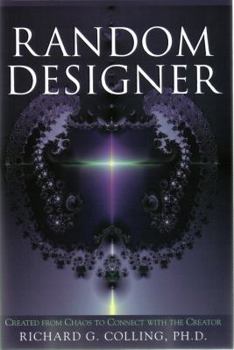
Random Designer: Created From Chaos To Connect With The Creator

Random Designer proclaims a new vision of God s creation. Written using simplified language and illustrations for working professionals, pastors, teachers, students and general audiences, Random... This description may be from another edition of this product.
Format:Hardcover
Language:English
ISBN:0975390406
ISBN13:9780975390405
Release Date:January 2004
Publisher:Browning Pr
Length:208 Pages
Weight:4.62 lbs.
Dimensions:9.3" x 1.0" x 6.3"
Customer Reviews
5 ratings
Random Design - Not an Oxymoron
Published by Thriftbooks.com User , 17 years ago
Random Designer presents a unique vision of God's creation. Utilizing easy-to-read personal narratives, Colling explains that the random processes that play such fundamental roles in the physical universe are actually tools of creation. God, the "Random Designer", harnesses these chaotic physical processes to bring about a Divine plan. The book is divided into three sections. Section I is devoted to describing and explaining the biological and chemical processes of life. Section II presents God as the powerful force behind the natural laws we observe. Colling suggests that instead of trying to stuff God into the traditional boxes of "Scientific Creationism" or "Intelligent Design," Christians should strive to understand scientific realities because the evidence will always be in God's favor. Section III concludes with the theme that mankind was "created for connection" with God. According to Colling, with this new understanding, humans are compelled to maximize our physical and spiritual potential. By doing so, we can hope to realize what it means to be made in God's image, to feel God's presence in our lives, and to experience an intimate, meaningful relationship with our Creator. I highly recommend this book because it presents some very deep theological concepts in a simple and easy to grasp way. Colling has written something with the potential to reach a lot of thinking Christians who would like to see an end to the "science vs. religion" aspect of the Creation/Evolution debate. In the very least, this book will challenge the reader to reconsider some critical issues related to the idea of God as Creator of all things.
Are you a biology novice? This is the book for you.
Published by Thriftbooks.com User , 18 years ago
Colling writes in a clear and understandable manner to show how biology, and in particular evolution, is in accord with basic Christian theology. Frankly if you have studied biology a good deal, you'll find this work rather repetitive and simplistic. You want to read something like Perspectives on an Evolving Creation or God After Darwin: A Theology of Evolution. But this book is ideal for the biology layman, who had little training or forgot what they learned previously, and never understood the basics of evolution. In a sense, Colling is the anti-Behe. Behe wants to show how there are some aspects of life that are inherently complex, and therefore couldn't have evolved. He therefore goes into great detail on the steps of different processes, to show how this is a complex process, and obviously, couldn't have happened "merely by chance". In doing so, he doesn't go into any greater detail than would be found in a myriad of other disciplines, in a higher-level text consulted by experts in the discipline. Behe thus gives an impression of false complexity. Colling instead shows how the basics of evolution are easily understandable, while recognizing that the theory is rather complex. Colling goes through evolution step by step, relating it to our understanding of God in the Bible, thus showing that the issue is more a matter of superior pedagogy and good heuristics, rather than objects which are "irreducibly complex". The first half of the book shows what evolution is, and why it's believable. Colling explains in concise terms ideas like entropy, neatly side-stepping misconceptions commonly held by Literal Creationists like entropy forbidding the development of complex lifeforms. The second half delves into what the meaning of all this evolution can have for our understanding of Christ as Christians. Particularly of note is the title idea- that randomness exists, and God uses this randomness in his design. Indeed, it is within this idea that Colling actually introduces some novel thoughts, on how failure is necessary for God's success. This is not a book to convince the unbeliever, nor is it groundbreaking for those who closely follow the Intelligent Design controversy, or the theology of evolution. It is however an excellent work for those new to the discussion, wishing to get their feet wet and understand the basics. In fact, for that purpose, I have never run across a finer book.
Challenging but Worth it
Published by Thriftbooks.com User , 21 years ago
This book addresses science and faith. Colling starts out discussing thst the purpose of the book is to attempt to reconcile, explain, and exlore the views of science and faith. The fist part of the book involves bringing non-science people up to speed on basic biological principles and research. The second part addresses the much more elusive aspect of why we were created as we were created. This book is like beef jerky. It is really tough to chew and the processing is slow at times, but when you get done, you have to have another piece. It is hard to reform ideas about creation from the Christian upbringing to accepting the scientific evidence. It would seem that God could have chosen evolution to create His most prized possession. The informationon the Second Law of Thermodynamics, radio isotope dating, the Big Bang theory, and the possible ways that the first life could have formed was extremely helpful and tactfully presented. The foundation set in the first part stands firm for the much more subjective second part. Some main points were that we were created to know the Creator, humans are the first creation with the ability to discern the presence of God, life is mainly about intimate relationships , and we are made in the image of God, therefore having the mind of God. No matter what veiws you hold on this issue, this would be a beneficial book for you to chew on.
Scientifically accurate and intelligible
Published by Thriftbooks.com User , 21 years ago
Random designer covers topic after topic, tackling the key issues surrounding biological evolution while integrating the Christian faith, and most importantly, God as the Random Designer. The book is appropriately separated into two sections: the fundamental science and the articulation of how this science matches up with the Random Designer's plan to create the human race in his image. In the first section, a variety of topics are covered, including: evolutionary stances, entropy, basic biochemical structures, natural selection, DNA, mutation, and aspects of the human mind. By keeping the foundation of biological evolution, God is found to have incorporated the laws that govern our universe, specifically emphasizing entropy and energy use in the production of a biological system that progresses by means of genetic mutation and natural selection. Throughout the last half, the connection between God and mankind is made through discussion subjects such as: God's image, selflessness, coming to know God, and the higher order random design. The possibility of "God's image" meaning "a mind of God" is suggested, leading the reader into the second section with the aspects of the human mind as a link to God and to his purpose. With this premise, the reader can recognize humanity's differentiation from all other species by means of self-awareness and God-awareness. This brings the conclusion that the human race is the desired product of God's creation scheme, in which he sets out to create a species that can acknowledge Him and live in his likeness by means of loose mental standardization. Maintaining reality into faith issues is something that often accumulates distorted opinions and black and white rainbows. Random Designer walks science alongside life, and in doing so, reveals the God who laid the path for the journey.
Highly informative to Christians and non-Christians alike
Published by Thriftbooks.com User , 21 years ago
"Random Designer" is a laudable attempt at reconciling the apparent discrepancy between religion and science. Much of the current debate as it plays out in contemporary politics is based on rigid either-or thinking that is far too dogmatic. Science offers a description of the universe but not an explanation. However, when Christians deny science it recalls the era when Galileo was tried for proclaiming that the earth revolves around the sun. God is the who of creation and evolution is the how. Any perceived contradiction is an illusion. Colling may be overstretching his case, e.g. in his criticism of intelligent-design theory. Even intelligent-design theory is not incompatible with science. Intelligent-design theory (a/k/a the teleological strand of Christian apologetics) holds that just as from observing a watch you conclude there must have been a watchmaker, the order of the universe suggests there was a Creator. True enough, but that still does not tell you much about the process by which the watchmaker actually produced the watch. In the case of the universe, think of science as the description of that process. The title-word "random" may be confusing insofar as it connotes a lack of divine purpose. Just because we cannot always (or often) discern a purpose does not mean there is none. But it is clear that Colling does not deny this, making this only a minor point. Overall I wholeheartedly recommend this slim, well-written volume. In the very least it will encourage you to think about critical issues that are normally treated with far too little nuance and understanding.
Copyright © 2026 Thriftbooks.com Terms of Use
| Privacy Policy | Do Not
Sell/Share My Personal Information | Cookie Policy | Cookie Preferences | Accessibility Statement
ThriftBooks® and the ThriftBooks® logo are registered trademarks of Thrift Books Global, LLC
ThriftBooks® and the ThriftBooks® logo are registered trademarks of Thrift Books Global, LLC
