


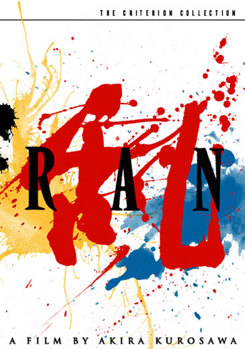
Ran

Select Format
Select Condition 
Product Description
Akira Kurosawa's brilliantly conceived retelling of Shakespeare's KING LEAR magically mixes Japanese history, Shakespeare's plot and Kurosawa's own feelings about loyalty in the epic masterpiece, RAN. Set in 16th century Japan, RAN relates the tale of how an aging ruler, Lord Hidetora (Tatsuya Nakadai), announces his intention to divide his land equally among his three sons. Hidetora's decision to step down unleashes a power struggle among the three heirs when he falls prey to the false flattery bestowed upon him by the two older sons and banishes the youngest for speaking the truth. That ruthless betrayal ultimately drives Hidetora insane, destroying his entire family and kingdom. Deep human emotion and outstanding acting combine to create one of the most acclaimed foreign films of all time.
Format:DVD
Language:English
UPC:715515016827
Release Date:May 1993
Rating:R (Restricted)
Publisher:Criterion Collection
Director:Akira Kurosawa
Starring:Tatsuya Nakadai, Mieko Harada, Satoshi Terao, Jinpachi Nezu, Daisuke Ryu, Yoshiko Miyazaki, Kazuko Kato, Masayuki Yui, Hitoshi Ueki, Hisashi Ikawa
Runtime:2 hours, 41 minutes
Number of Disks:2
Other Video Info:Color; Dolby; DVD; Special Edition; Subtitled; Widescreen; NTSC
Weight:0.44 lbs.
Dimensions:1.0" x 5.5" x 7.8"
Related Subjects
DramaCustomer Reviews
1 rating
This could've been a miniseries.
Published by bernie4444 , 4 months ago
Well, I have to confess that I have seen many Shakespeare plays but not King Lear; so, this is not a comparison review.
I heard about this movie and Akira Kurosawa and read the reviews. So I figured it was time to plug a hole in my cultural vacuum. I'm not that artsy, so I didn't expect the results.
Starting this film, I realized that I was going to have to rely totally on the subtitles. I have been in J-a-p-a-n, but the only words that are recognized are the few that were written on Amazon.ja. Before I even got comfortable, subtitles were sucked into the story and the characters. Now I was hooked. I not only wanted to know what everybody was doing, but what they were doing when they were not on the screen. While the movie was running, I kept thinking now it's going to stop. But no, it went on and on and on. Then, when I wished, it would keep going on, and on and on; it was over. This is one of those movies that you wish there was a sequel, but you know that wouldn't be practical. So be prepared to lose yourself in another reality.
The basic story is that Lord Hidetora Ichimonji (Tatsuya Nakadai), after a ruthless career of conquering the neighbors and killing off rivals, has finally brought the territory under peace and his absolute rule. Now that he is about to retire, he hands the reins over to his eldest son, to the consternation of the two younger sons, who expected to share in the power. He lets them know they can share by supporting the eldest son. You can see the formula, but have no idea how it really will turn out with the two younger sons, old rivals, a disgruntled brat (okay, Fox) wanting her Castle back, and many other subplots.
One side note is that as I watched Lord Hidetora Ichimonji’s slow disintegration, I could see my father now in his 90s and relate because this movie was so real, not just the play.
Just an observation, I found the contrast between the primitive countryside and sloppily built castles, compared to the intricate eating utensils and clothing, to be surprising. It makes you wonder if it was that way. And I'm not quite sure what they were trying to say when they were p-u-s-s-y-f-o-o-t-i-n-g around between Buddhism and Shintoism.
The DVD that I watched had several extras that, this time, instead of being in J-a-p-a-n-e-s-e is now in French with English subtitles. As with most extras, watching the movie again with this knowledge adds a new dimension.
Copyright © 2026 Thriftbooks.com
Terms of Use | Privacy Policy | Do Not Sell/Share My Personal Information | Cookie Policy | Cookie Preferences | Accessibility Statement
ThriftBooks ® and the ThriftBooks ® logo are registered trademarks of Thrift Books Global, LLC
ThriftBooks ® and the ThriftBooks ® logo are registered trademarks of Thrift Books Global, LLC
