


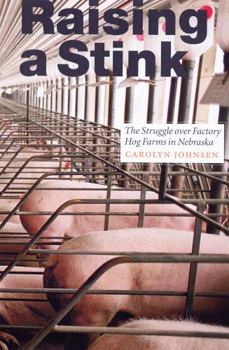
Raising a Stink: The Struggle Over Factory Hog Farms in Nebraska

In Nebraska, as in many states across the nation, factory farms housing tens of thousands of hogs have altered the physical, cultural, and economic landscape, and have generated complex and deeply divisive conflicts among family farmers, environmentalists, agribusinesses, and elected officials. A reporter long familiar with the controversy, Carolyn Johnsen draws on a wealth of interviews, archival material, and her own extensive experience as a journalist to present a timely, informative, and balanced account of this complicated and troubling agricultural practice--and to put a human face on its causes and consequences. Here everyone has a say: farmers and neighbors suffering from proximity to the factory hog farms; pork producers adopting the latest hog confinement technology in the face of fierce opposition; politicians attempting to interpret the "science" and shape public policy in a maelstrom. The result is the story of a struggle for the heart and soul of rural America.
Format:Paperback
Language:English
ISBN:0803276176
ISBN13:9780803276178
Release Date:September 2003
Publisher:Bison Books
Length:181 Pages
Weight:0.10 lbs.
Dimensions:0.5" x 6.0" x 9.1"
Customer Reviews
3 ratings
The author's work shines in "Raising a Stink"
Published by Thriftbooks.com User , 21 years ago
I recently finished reading this book, and I am very impressed with it. I consider it an outstanding work of journalism. Johnsen reports on many events over several years, and in every paragraph she is thorough, detailed and fair. The book tells an always-interesting story of the spirited yet civil debates not only about factory farms, but about the future of farming, some of which I too witnessed and reported from 1997 to 2002 as a newspaper writer.It is not real surprising to me, as a life-long Nebraskan, that Nebraska and its people are deeply involved in such a vital discussion, and although it is still unsettled, I am proud to see how it is faced. I think the outcome of this debate will influence the future of land, probably for another 100 years or so. Nebraska has a long tradition of small farms, small governments and individual rights. The slow, steady march of business is enlarging the size of farms at the same time many older farmers and baby boomers are retiring. Younger farmers seek work elsewhere. For me, the profound question is -- should the future of farming be solely determined by economic efficiency; or, should farms be a place where many independent people live and work? This book is all about how people brought their beliefs on that issue to bear on reality. They not only considered the strong odors, potential enviromental harm and economic impacts of factory hog farms, they tried to apply the principles of fairness, justice and liberty. Significantly enough, the events in this book occurred at the turn of the millennium. As is always the case, the future depends on what people choose to do, or not do, about the challenges that face them each day, week, month and year. For anyone who is and wants to be involved in creating the future of agriculture, I especially recommend this book. It gives a strong foundation of accurate information about how rural residents, business as well as state and local governments behave when challenged with issues of immediate consequence and lasting importance. Congratulations, Carolyn.
Jim Reese -- Lincoln Journal Star
Published by Thriftbooks.com User , 22 years ago
A friend of mine, and fellow colleague that teaches in the English department is always asking me what my infatuation with hogs is. He says, everywhere I look, there's a pig. A pig on your desk, a pig on the cover of your book, a picture of you and a pig walking down a dirt road. You own pigs or what? He asked me one day. Kind of, I answered. I own the one that's in my deep freeze. I bought it. I butchered it with some help and I now I'm eating it-trying to do my part to save and support the family farm. How's that for an answer?Well, for some readers it might make perfect sense and to others it might not. The question addressed over and over again in Raising A Stink-the Struggles over Factory Hog Farms in Nebraska is farming. What is real farming and/or who is the real farmer? Carolyn Johnsen addresses these questions and investigates the controversies over these complicated corporate ventures and what is being done to save the heart and soul of rural America.Carolyn Johnsen is no stranger to controversy. Johnsen is an award winning reporter and associate producer for news and public affairs at Nebraska Public Radio Network After reading about the Hog Hilton's and Initiative 300 I wanted to know where she stood on this issue. "People often ask for my opinion about factory-like hog farms. It's not so simple as saying this method of raising livestock is good or bad. Some farmers profitably raise pigs in confinement without harming their neighbors' lives or the environment. Others profit at the expense of both the environment and their neighbors' good will. Policymakers struggle--with mixed results--to reconcile conflicting values and science related to the issue. I hope Raising A Stink informs the debate and helps readers to decide which side the accumulated evidence comes down on."Raising A Stink makes the hair on the back of my neck stand. It scares me to think of what the Plains are turning into. It burns me, to think of what is happening to families struggling from harvest to harvest.
Not just Nebraska!
Published by Thriftbooks.com User , 22 years ago
Although the focus of this book is on Nebraska farming, the issues are much more universal. Johnsen's balanced analysis of factory production versus family farm production lets the reader make the value judgements. This book will also encourage a thoughtful reader to consider the sources of food production in related industries, including poultry and seafood. If you care where your food -- particularly your pork -- comes from, then you should read this book.
Copyright © 2025 Thriftbooks.com
Terms of Use | Privacy Policy | Do Not Sell/Share My Personal Information | Cookie Policy | Cookie Preferences | Accessibility Statement
ThriftBooks ® and the ThriftBooks ® logo are registered trademarks of Thrift Books Global, LLC
ThriftBooks ® and the ThriftBooks ® logo are registered trademarks of Thrift Books Global, LLC
