


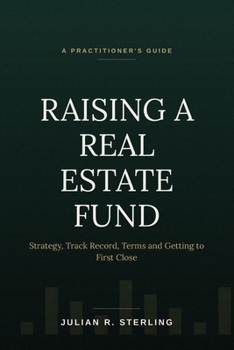
Raising a Real Estate Fund: A Practitioner's Guide to Strategy, Track Record, Terms and Getting to First Close

A fundraise is not a pitch of an idea. It is an examination of an institution - and most first-time funds fail on organisation rather than on strategy.
This is a practitioner's guide to the whole machinery of raising a real estate fund: from the sentence an investment committee has to be able to repeat back to you, to the wire arriving at first close.
What you are actually selling. Repeatability, not brilliance. What an allocator tests - can you source it, execute it, survive it, report it - and why a strong deal record does not by itself make a fundable manager.
The evidence.
Track record that survives diligence: realised against unrealised, gross against net and every layer between, loss ratio, and the presentation choices that quietly misleadThe attribution problem - sourced, executed, managed, exited are four separate claimsDeployment arithmetic that proves the fund can actually be investedThe vehicle and its economics. Closed-end, open-end, evergreen and separate accounts, and the failure mode of each wrong choice. The management fee as a budget rather than a prize, with a break-even calculation. The waterfall worked in full: hurdle, catch-up, whole-fund against deal-by-deal, the interaction with leverage, and why an unsecured clawback is worth little.
The terms that decide behaviour. Investment period, recycling, leverage caps, concentration limits, subscription lines and their effect on reported returns - plus the governance and alignment provisions behind them.
The process. Segmenting the investor base, anchor investors and what they cost, placement agents and consultants, the operational due diligence that kills deals quietly, the data room and the discipline of answering badly only once, and equalisation at the second close.
The book teaches architecture rather than rules. It asserts no jurisdiction's law, recommends no domicile, names no firm, regulator or product; every figure is fictional and worked through.
Five appendices make it usable: the fundraising file with owners and deadlines, ninety questions investors actually ask, four fully worked economics cases, a twelve-month calendar, and a glossary of around seventy terms.
For first- and second-time managers, capital formation and investor relations professionals, placement and advisory teams - and for the allocator who wants to see the machinery from the inside.
Customer Reviews
ThriftBooks ® and the ThriftBooks ® logo are registered trademarks of Thrift Books Global, LLC
