


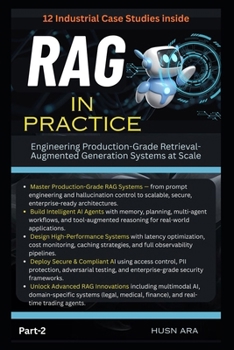
RAG in Practice: Engineering Production-Grade Retrieval-Augmented Generation Systems at Scale (RAG in Practice Beginner to Advanced Level)

In today's AI-driven world, building Retrieval-Augmented Generation (RAG) systems is no longer optional-it's essential. RAG in Practice is a comprehensive, engineering-focused guide that takes you far beyond theory, delivering a complete blueprint for designing, deploying, and scaling production-grade RAG systems.
This book is crafted for AI engineers, data scientists, and architects who want to move from experimentation to enterprise-ready intelligence systems.
What You'll Master
Part I: Generation, Prompting, and Grounding
Lay the foundation with advanced prompt engineering techniques, context injection strategies, and instruction hierarchies. Learn how to systematically eliminate hallucinations through grounding, citation enforcement, and uncertainty calibration. Dive into structured outputs, tool calling, and real-world enterprise assistant design.
Part II: Evaluation and Observability
Understand how to measure what matters. Build golden datasets, automate retrieval testing, and evaluate generation quality at scale. Gain deep insights into observability with logging, tracing, and root cause analysis-essential for debugging production failures.
Part III: Production-Grade RAG Systems
Move into real-world deployment with microservices architecture, cloud-native design, and Kubernetes-based scaling. Learn latency optimization, caching strategies, and cost engineering. Secure your systems with OAuth2, JWT, PII detection, and defenses against prompt injection attacks.
Part IV: Advanced and Emerging RAG Patterns
Explore the frontier of AI systems:
Build cutting-edge systems like:
Self-learning agents with evolving memoryLangGraph-style multi-agent workflow enginesMultimodal financial forecasting agentsReal-time trading RAG systems with streaming, forecasting, and executionWhy This Book Stands OutEnd-to-end system design (not just concepts)Production-grade architectures and pipelinesReal-world case studies across industriesPerformance, cost, and security deeply coveredAdvanced topics rarely documented elsewhere
Who This Book Is ForAI Engineers building production systemsData Scientists scaling LLM applicationsArchitects designing enterprise AI platformsResearchers exploring next-gen RAG systems
Build What Others Only Talk About
By the end of this book, you won't just understand RAG-you'll be able to:
Design secure, scalable, and efficient AI systemsDeploy enterprise-grade RAG pipelinesBuild autonomous, multimodal, domain-aware agentsThis is not just a book-it's a complete engineering playbook for the future of AI systems.
Customer Reviews
ThriftBooks ® and the ThriftBooks ® logo are registered trademarks of Thrift Books Global, LLC
