


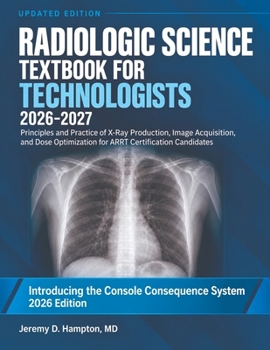
Radiologic Science Textbook for Technologists 2026-2027: Principles and Practice of X-Ray Production, Image Acquisition, and Dose Optimization for ARR

Know What Every Console Control Costs Before You Press Expose
Radiography programs teach physics in a classroom months before the console it governs, and the result is a technologist who can raise kilovoltage without knowing what the change does to patient dose. This textbook covers the full scope of radiologic science for imaging professionals: x-ray production and tube engineering, photon interactions and attenuation, exposure technique and image quality, digital acquisition and processing, fluoroscopy and adjunct modalities, radiobiology, and radiation protection. Its organizing premise is that every console control changes three things at once, and that the physics, the image, and the dose belong in the same paragraph rather than in three different semesters.
Twenty-eight chapters, 168 indexed console consequences, and a back-of-book atlas built for lookup at the workstation rather than for reading through.
What this textbook equips you to do:
- Emission spectra, half-value layer, and beam quality - predict how any exposure factor changes the beam before you select it
- Photoelectric and Compton interaction balance - explain why contrast falls as kilovoltage rises, and decide when that trade is acceptable
- The fifteen percent rule, grid conversion factors, and distance compensation - apply every technique conversion in combination without a chart
- Exposure indicators and the deviation index - read the only feedback a digital department gives you on the radiation you actually used
- Dose creep mechanism and departmental monitoring - recognize the systematic overexposure that no single image will ever reveal
- Automatic exposure control failure modes - identify when chamber selection, hardware, or minimum response time makes manual technique the lower-dose choice
- Fluoroscopic dose metrics and skin injury thresholds - monitor cumulative air kerma during a procedure while mitigation is still available
- Radiobiology, tissue weighting, and fetal dose by gestational stage - answer a patient's risk question accurately rather than dismissively
Build the reasoning that outlasts every revision of the numbers, and take it to the console.
Customer Reviews
ThriftBooks ® and the ThriftBooks ® logo are registered trademarks of Thrift Books Global, LLC
