


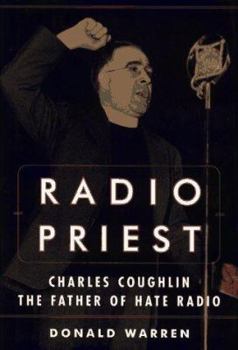
Radio Priest: Charles Coughlin, The Father of Hate Radio


"International bankers" was a code description Charles E. Coughlin, a Roman Catholic Priest, used on his radio show; he did not need to say "Jewish international bankers," to make it clear whom he was... This description may be from another edition of this product.
Format:Hardcover
Language:English
ISBN:0684824035
ISBN13:9780684824031
Release Date:July 1996
Publisher:Free Press
Length:384 Pages
Weight:1.55 lbs.
Dimensions:9.8" x 1.0" x 6.8"
Customer Reviews
5 ratings
Flawed, but still excellent biography
Published by Thriftbooks.com User , 23 years ago
"Radio Priest" is meant to remind people the author fears have both forgotten Father Charles Coughlin and may be unwisely underestimating those eager to apply his brand of media manipulation in the age of the internet. From the depths of the depression until shortly after America's entry into WWII, Coughlin, a Detroit Priest had become a political force of nature. Using his radio show and "Social Justice" his newspaper, he spread his message across the nation - a message that grew progressively overt in anti-Semitism and Facist advocacy. With the severity of the depression destroying lives across the world, the time was ripe for many to question democracy - as they had across the world, the popularity of socialism and fascism flourished across America. Though many figures grew out of the clash of these movements, Coughlin stood out - mostly because his position as a priest but mostly because of the eloquence with which he gave his fans the message they wanted to hear. He even possessed his own trademark accent, with its distinctive rolling rrr's. Coughlin attacked banking interests and polticians - codewords for the jews and those they were thought to have bought. Confronted with growing reports of Germany's anti-Semitic repression, he claimed sympathy for the jews, but attributed Germany's conduct to a natural response to Jewish Bolshevism. Ostensibly adhering to a religion which had suffered religious intolerance, Coughlin adopted the same penchant for mass hysteria as those who had victimized other Catholics. Though war with fascism forced him into a sort of hiatus, Coughlin's decline had actually begun with the 1936 Presidential Elections. Unsatisfied with GOP front-runner Alf Landon, and seized by an outright hatred for FDR, Coughlin campaigned fiercely for the Social Justice candidate, William Lemke. Those left unfulfilled by FDR and unimpressed with Landon, flocked to Coughlin and his allies. Among them, Francis Townsend seemed more dignified, GLK Smith had more energy and Huey Long had more savvy, but Coughlin possessed something of the qualities of all three. Though Coughlin had the power, he displayed little interest in using it for even his idea of a greater good, and the social justice ticket ballot was dwarfed even by Landon's showing. By then, Long was dead by an assassin's bullet, and his political machine in Louisiana collapsed under the weight of its own corruption. Emboldened by his landslide, FDR embarked on a strategy to fast-track the New Deal with legislation designed to end run a hostile supreme court and thinly veiled threats to pack the high court if the first idea didn't work out. Coughlin, on the other hand, now embittered with politics, lost much of his dignified veneer. Both in his own tone and those of his followers, Coughlin became more closely identified with all that was bigoted in domestic fascism. By 1940, Coughlin had been sufficiently cut down to manageable size for his own church's hierarchy,
Excellent account
Published by Thriftbooks.com User , 24 years ago
This is an excellent biography of one of the most appalling figures in recent American history. Father Coughlin was a hatemonger, an anti-Semite of tremendous proportions, and often a liar. That ANYONE could believe him to be worthy of praise, let alone "the sort of priest we need more of," is a sad, sad commentary on America.It is hard to believe that Father Coughlin was allowed to stay on the air and spew his poison for as long as he did. I wonder what he would have thought of the death camps? Or would he have found a way to deny the fruit of his hateful, unchristian ravings?
The kind of priest Jesus would be proud of.
Published by Thriftbooks.com User , 24 years ago
Father Coughlin had the spine to say what he belived and told the truth as he seen it. Too bad we don't have Catholic priest today with the...[guts] to tell it like it is.How can anyone not see what going on in the media with the soul murder of the American people by the people the good priest warned us about.God bless Father Coughlin
Father Hate
Published by Thriftbooks.com User , 25 years ago
This is a fine biography of a ( ) dressed in the cloak of thechurch. It works on several levels. Warren shows how there is alwaysa ready ear even for the most reactionary prattle, especially when there is crisis in the air. The book also works as a fine bit of historical investigative journalism. Coughlin's connections to the Nazis has never been as clearly laid as in this book. Highly recommended. END
Intriguing mix of history and present day warning.
Published by Thriftbooks.com User , 26 years ago
Every cursory study of the Great Depression and the New Deal includes a brief reference to Catholic priest Father Charles Coughlin whose radio broadcasts savaged FDR and his advisors, but especially attacked the Jews and perpetuated the myths of Jewish conspiracies. Always, Coughlin is mentioned in passing and then the text moves on. Donald Warren's "Radio Priest" gives Coughlin and his times the attention and thoughtful analysis they deserve. Warren asserts that Coughlin was more than a priest who used his radio pulpit to spread his anti-semetic beliefs, but also as the father of hate radio. Warren connects Coughlin's career as a broadcaster in the early twenties to late thirties to today's radio and television commentators who champion racism in the name of fair-mindedness. In times of great poverty, Warren says, those who feel disenfranchised and powerless need to be part of the system or need to tear it down. The Great Depression and Coughlin seemed made for each other, and the priest definitely used the anger of the working class to propel himself to fame and eventually notoriety. Coughlin eventually alienated himselft from the government and his own Roman Catholic superiors and accepted an enforced silence to avoid possible federal prosecution. Warren amply explores the Catholic Church's growing discontent and embarrassment of its priest, and eventual plan to silence him. For those who always wondered why his superiors didn't stop Coughlin sooner, this books explains it in detail, including the Church's fear that Coughlin would resign and take his "radio flock" with him. He also discusses how the federal government conspired with Coughlin's bishop to stop the renegade priest. Unfortunately, there is little discussion as to why the priest did these things, but Warren can't be blamed for that. His book stands as a perfect example of well-researched and clearly written biography. We just must accept that Coughlin gave no reason for his professed hatred of Jews, or that he actually believed what he wrote and spoke. The reader is also left to wonder why Coughlin continued to bait his superiors and his government despite mounting pressure. By not speculating why Coughlin broadcast his vile messages or why he didn't stop until caught in a legal vise, Warren actually moves Coughlin from his traditional place as a Depression-era demagoue to a position in line with the mass media hate broadcasters of today. The lesson by comparison is chillingly clear: Coughlin wasn't an aberrant case, but a pioneer who blazed the way for others. An excellent biography and history of America's most troubled and fragile time.
Copyright © 2026 Thriftbooks.com Terms of Use
| Privacy Policy | Do Not
Sell/Share My Personal Information | Cookie Policy | Cookie Preferences | Accessibility Statement
ThriftBooks® and the ThriftBooks® logo are registered trademarks of Thrift Books Global, LLC
ThriftBooks® and the ThriftBooks® logo are registered trademarks of Thrift Books Global, LLC
