


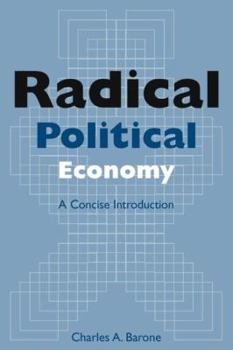
Radical Political Economy: A Concise Introduction: A Concise Introduction


Select Format
Select Condition 
Book Overview
This straightforward introduction to radical political economy strikes a balance between breadth and depth and was written for the beginning student and others interested in a relatively short text on... This description may be from another edition of this product.
Format:Paperback
Language:English
ISBN:0765613654
ISBN13:9780765613653
Release Date:January 2004
Publisher:Routledge
Length:184 Pages
Weight:1.25 lbs.
Dimensions:0.5" x 6.0" x 8.9"
Customer Reviews
1 rating
Full of things that radicals understand
Published by Thriftbooks.com User , 20 years ago
This is a nice, little college textbook capable of preparing students to engage in reasonable debate about political goals. It is timely in a society that has adopted capitalist ideology as the normative frame of reference for picturing how to compete in a world that offers numerous social and political models for maintaining economic activity in a world that has gone mad for gaming, file-sharing, free money, government's stimuli, and a host of financial shenanigans. Allow me to refer to RADICAL POLITICAL ECONOMY A Concise Introduction by Charles A. Barone (M. E. Sharpe, Inc., 2004) as RPE, and compare it to the free market in which everyone expects to get something for nothing due to the oversupply of expired patents, shared technologies, and the tendency of everything financial to expand to the point of collapse, which I shall call The Subversive Morbidity. RPE's Chapter 1 is about Marx. It includes formulas for determining the total value of production. Also, "Marx analyzed four tendencies that produced economic crisis." (p. 16). Common today is what Marx called "the relative impoverishment of the working class." (pp. 17-18). The Subversive Morbidity still rushes "to embrace a rich cultural being that included our artistic, intellectual, and spiritual abilities." (p. 18). Chapter 2 starts with "Radical political economy (RPE) consists of a particular methodology, theoretical analysis of capitalism, and vision for the future." (p. 24). Figure 2.1 shows a Holistic View of Society, four intersecting circles, about 300 million fewer than the richly Subversive Morbidity. The big dig at capitalist oppression shows up in Chapter 3. "Once they go to work and go through the factory or office doors, they enter the world of work, . . . In fact, under capitalism the world of work is regulated by command not voluntary exchange. Many U.S. Constitutional rights held by citizens in the larger society, such as free speech and assembly, are not recognized within the factory or office where the rights of private property are sovereign." (p. 61). "The social organization of the labor process in RPE is determined to a significant extent by capitalist strategies to control workers in order to extract as much work from them as they can." (p. 65). Chapter 4 goes further in the global dimension. "Capitalist domination over workers would be incomplete if capitalists did not also dominate culture and use existing cultural creations to their advantage." (p. 79). "Capitalist domination of the media, together with education, ensures that the dominant ideology propagated in society will legitimate capitalist domination of production and the labor process." (p. 84). Things that government can do find an evaluation in Table 4.1, Government Policies and the Rate of Profit (p. 95). Chapter 5 examines income inequality and the usual daily economic news item, "Capitalism and Cyclical Economic Crisis." (pp. 111-116). Everyone hopes we can expect "Long-
Copyright © 2026 Thriftbooks.com Terms of Use
| Privacy Policy | Do Not
Sell/Share My Personal Information | Cookie Policy | Cookie Preferences | Accessibility Statement
ThriftBooks® and the ThriftBooks® logo are registered trademarks of Thrift Books Global, LLC
ThriftBooks® and the ThriftBooks® logo are registered trademarks of Thrift Books Global, LLC
