


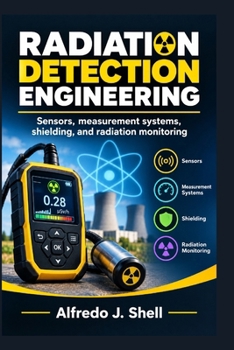
RADIATION DETECTION ENGINEERING: Sensors, measurement systems, shielding, and radiation monitoring
No Customer Reviews

RADIATION DETECTION ENGINEERING provides a structured exploration of the engineering principles used to detect, measure, monitor, and characterize ionizing radiation. It connects radiation physics with detector technologies, measurement systems, signal processing, shielding concepts, instrumentation, and radiation monitoring applications. Radiation detection systems are designed to convert interactions between radiation and detector materials into measurable signals. Building and operating these systems requires an understanding of radiation sources, detector response, electronic signal processing, calibration, measurement uncertainty, environmental effects, and system performance. The book introduces the fundamental principles behind radiation detection and examines how different types of radiation interact with matter. It explores the characteristics of alpha particles, beta particles, gamma radiation, X-rays, and neutrons, together with the physical principles that allow detection systems to identify and measure radiation. Particular attention is given to radiation sensors and measurement instrumentation. Detector technologies such as scintillation detectors, semiconductor detectors, gas-filled detectors, and related sensing approaches are examined from an engineering perspective. The book also considers signal amplification, pulse processing, counting systems, energy measurement, data acquisition, and monitoring. Key topics include: * Fundamentals of radiation detection
* Ionizing radiation and radiation interactions
* Alpha, beta, gamma, X-ray, and neutron detection
* Radiation detector technologies
* Gas-filled radiation detectors
* Scintillation detector systems
* Semiconductor radiation detectors
* Radiation sensors and instrumentation
* Signal amplification and pulse processing
* Radiation counting and measurement
* Energy spectrum measurement
* Calibration and detector characterization
* Measurement uncertainty and system performance
* Radiation monitoring systems
* Data acquisition and signal analysis
* Portable and fixed monitoring equipment
* Radiation shielding principles
* Shielding materials and attenuation
* Background radiation and interference
* Environmental radiation monitoring
* Detector maintenance and reliability
* Radiation safety and monitoring practices The book also examines how detection hardware, electronic processing, software, monitoring systems, and shielding considerations work together within a complete radiation measurement architecture. Reliable detection depends not only on the detector itself but also on calibration, signal conditioning, environmental conditions, data interpretation, and appropriate system design. RADIATION DETECTION ENGINEERING is intended for engineering and physics students, radiation instrumentation professionals, nuclear technology learners, technicians, researchers, and readers seeking a structured foundation in radiation detection and measurement systems. It approaches the subject from an engineering perspective while emphasizing the relationship between radiation physics, sensors, electronics, measurement, monitoring, and system reliability. Build a stronger understanding of how radiation becomes a measurable signal. Scroll up and obtain your copy now to explore radiation detectors, measurement systems, shielding principles, instrumentation, and modern radiation monitoring technologies.
* Ionizing radiation and radiation interactions
* Alpha, beta, gamma, X-ray, and neutron detection
* Radiation detector technologies
* Gas-filled radiation detectors
* Scintillation detector systems
* Semiconductor radiation detectors
* Radiation sensors and instrumentation
* Signal amplification and pulse processing
* Radiation counting and measurement
* Energy spectrum measurement
* Calibration and detector characterization
* Measurement uncertainty and system performance
* Radiation monitoring systems
* Data acquisition and signal analysis
* Portable and fixed monitoring equipment
* Radiation shielding principles
* Shielding materials and attenuation
* Background radiation and interference
* Environmental radiation monitoring
* Detector maintenance and reliability
* Radiation safety and monitoring practices The book also examines how detection hardware, electronic processing, software, monitoring systems, and shielding considerations work together within a complete radiation measurement architecture. Reliable detection depends not only on the detector itself but also on calibration, signal conditioning, environmental conditions, data interpretation, and appropriate system design. RADIATION DETECTION ENGINEERING is intended for engineering and physics students, radiation instrumentation professionals, nuclear technology learners, technicians, researchers, and readers seeking a structured foundation in radiation detection and measurement systems. It approaches the subject from an engineering perspective while emphasizing the relationship between radiation physics, sensors, electronics, measurement, monitoring, and system reliability. Build a stronger understanding of how radiation becomes a measurable signal. Scroll up and obtain your copy now to explore radiation detectors, measurement systems, shielding principles, instrumentation, and modern radiation monitoring technologies.
Format:Paperback
Language:English
ISBN:B0HKMBYT9H
ISBN13:9798175727952
Release Date:September 2026
Publisher:Independently published
Length:235 Pages
Weight:0.71 lbs.
Dimensions:9.0" x 0.5" x 6.0"
Customer Reviews
0 rating
Copyright © 2026 Thriftbooks.com
Terms of Use | Privacy Policy | Do Not Sell/Share My Personal Information | Cookie Notice | Cookie Preferences | Accessibility Statement
ThriftBooks ® and the ThriftBooks ® logo are registered trademarks of Thrift Books Global, LLC
ThriftBooks ® and the ThriftBooks ® logo are registered trademarks of Thrift Books Global, LLC
