


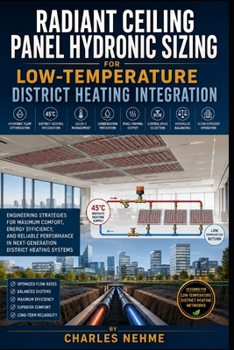
Radiant Ceiling Panel Hydronic Sizing for Low-Temperature District Heating Integration: Hydronic Flow Optimization, 45°C District Heating Integration,

The transition toward lower-temperature district heating is changing the way engineers approach building heating systems. District energy networks that once delivered relatively high water temperatures are increasingly being designed and operated at lower temperatures to improve distribution efficiency, increase renewable-energy compatibility, facilitate heat-pump integration, recover waste heat, and reduce overall carbon emissions.
A 45 C district heating supply temperature presents an especially interesting engineering opportunity. It can support highly efficient commercial buildings, but it also demands a different approach to heat-emitter selection, hydronic distribution, controls, hydraulic balancing, and system commissioning.
Radiant ceiling panels are particularly well suited to this transition. They can provide comfortable and relatively uniform heating while operating with water temperatures considerably lower than those traditionally associated with conventional radiators. Their large active surface area allows useful heat transfer at moderate water temperatures, making them an attractive interface between modern low-temperature district heating networks and commercial occupied spaces.
However, successful integration cannot be achieved simply by connecting radiant panels to a district heating loop.
The engineer must consider the relationship between panel surface temperature, room conditions, water temperature, water flow, circuit configuration, pressure loss, control-valve authority, hydraulic balancing, and building heat demand. Every part of the system influences the others.
This book approaches that challenge from a practical engineering perspective.
Rather than presenting the subject as a collection of theoretical equations, the discussion focuses on how engineers actually make design decisions. The objective is to provide procedures, selection criteria, practical tables, commissioning guidance, troubleshooting methods, and qualitative relationships that can be applied during conceptual design, detailed engineering, design review, retrofit assessment, and commissioning.
Particular attention is given to the challenges of operating radiant ceiling panels with approximately 45 C district heating water. The book examines how to select appropriate operating conditions, distribute water effectively, maintain useful temperature differences, prevent condensation where relevant, control individual zones, balance circuits, and extract maximum value from the available district-heating temperature.
Customer Reviews
ThriftBooks ® and the ThriftBooks ® logo are registered trademarks of Thrift Books Global, LLC
