
Skip to content
Scan a barcode
Scan
Paperback Radar Cross Section Book

ISBN: 1891121251

ISBN13: 9781891121258

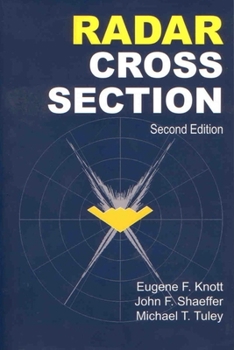
Radar Cross Section

Select Format

Select Condition ThriftBooks Help Icon

Recommended

Format: Paperback

Condition: Like New

$95.39
Save $59.61!
List Price $155.00
Almost Gone, Only 1 Left!

Book Overview

Radar cross section (RCS) is a comparison of two radar signal strengths. One is the strength of the radar beam sweeping over a target, the other is the strength of the reflected echo sensed by the receiver. This book shows how the RCS gauge can be predicted for theoretical objects and how it can be measured for real targets. Predicting RCS is not easy, even for simple objects like spheres or cylinders, but this book explains the two exact forms of theory so well that even a novice will understand enough to make close predictions. Weapons systems developers are keenly interested in reducing the RCS of their platforms. The two most practical ways to reduce RCS are shaping and absorption. This book explains both in great detail, especially in the design, evaluation, and selection of radar absorbers. There is also great detail on the design and employment of indoor and outdoor test ranges for scale models or for full-scale targets (such as aircraft). In essence, this book covers everything you need to know about RCS, from what it is, how to predict and measure, and how to test targets (indoors and out), and how to beat it.

Customer Reviews

2 ratings

Not a bad qualitative discussion on radar cross section

This book discusses, at an introductory level, the concepts of radar cross section and electromagnetic scattering phenomena. It also goes over some of the computational techniques used in the area of RCS prediction, such as physical optics, diffraction, and the method of moments. There are also several sections that talk about radar absorbing materials (RAM) and RCS reduction. Most of the equations in this book are, however, useless as far as implementation in a production-level numerical code. To do so, the reader will need to go back to the original sources (which the authors do reference) and go from there.

Best book on RCS technology

Knott, Shaeffer, and Tuley don't tell us everything about stealth, naturally, but within the limits of a single, unclassified volume this is about as balanced and comprehensive an overview as could be wished. The approach is physical rather than purely mathematical. A good background in electromagnetics is needed for full mastery of the material, but a more limited knowledge of electricity and magnetism will still allow good basic comprehension. Even full mastery of the book won't make you a qualified RCS engineer, but it provides a good basis for further study as well as an excellent resource for those who need an overall design and technology perspective, or must communicate clearly with specialists. I've consulted it over and over in the 15 years since I acquired a copy of the first edition. The second edition has important improvements, although the first edition remains useful in many areas.Will O'Neil
Copyright © 2025 Thriftbooks.com Terms of Use | Privacy Policy | Do Not Sell/Share My Personal Information | Cookie Policy | Cookie Preferences | Accessibility Statement
ThriftBooks ® and the ThriftBooks ® logo are registered trademarks of Thrift Books Global, LLC

GoDaddy Verified and Secured