


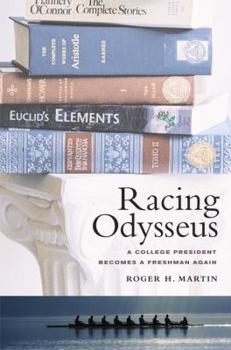
Racing Odysseus : A College President Becomes a Freshman Again

Select Format
Select Condition 
Book Overview
The idea of reliving youth is a common fantasy, but who among us is actually courageous enough to try it? After surviving a deadly cancer against tremendous odds, college president Roger H. Martin did... This description may be from another edition of this product.
Format:Hardcover
Language:English
ISBN:0520255410
ISBN13:9780520255418
Release Date:August 1970
Publisher:University of California Press
Length:280 Pages
Weight:0.09 lbs.
Dimensions:0.9" x 5.5" x 8.3"
Customer Reviews
5 ratings
Plato + rowing = entrancing
Published by Thriftbooks.com User , 17 years ago
This is a charming look at the opening freshman semester at St. John's College in Annapolis, Maryland. However, the student through whose eyes we see is no eighteen-year-old just out of high school. Instead, Roger H. Martin, the then sixty-one-year-old president of Randolph-Macon College and a cancer survivor, used a four-month sabbatical to return to school as a student. Martin was drawn to St. John's because of its Great Books curriculum in which all students read the same classical titles during a rigorous four-year-program and learn through discussing these books in small, group tutorials. Freshmen begin with the ancient Greeks: Homer, Aeschylus, and Sophocles...moving soon to Herodotus and Plato, among others. Martin noted, "Even though the books we read in seminar are ancient, it is amazing how relevant virtually all of them are to modern society." One of Martin's gifts is being able to readily perceive and translate the relevance to the readers. Indeed, the title of this account, Racing Odysseus: A College President Becomes a Freshman Again blends Martin's academic observations (he read all the books required, but he was not an active participant in the discussions) with his chance to join the rowing team and prepare to race in a regatta as part of an eight-man boat. On one very rainy day when the team couldn't safely practice on water, some wag wrote lines from Sophocles' Antigone on the gym blackboard: " 'Many are the wonders, none so more wonderful than what is man / It is he who crosses the sea / With the south winds and the waves swelling / Breaking around him in roaring surf.' " St. John's distinguishes itself from other colleges and universities by encouraging all students to go out for any sport -- preferably one they have never tried before but have wanted to play. Martin's honest admissions of his own insecurities but unbowed perseverance as a novice rower compose a considerable part of his tale, honing the message that preparing young adults for life in college should engage both mind and body. Martin did his best to become one of the freshman class, going to their Waltz Dance, "hanging out" at the coffee shops where the kids congregated, etc. He did forget to attend the choral practices mandatory for freshmen, so he didn't know the words when the entire student body broke out in a harmonied rendition of Palestrina's SICUT CERVUS However, try as he would, he still found himself counseling homesick young people and being asked to dinner by faculty members -- hardly the norm for a freshman unless he is also a college president. If RACING ODYSSEUS has an Achilles heel, it is that the reader may pine for more intensive material about the seminar discussions of the classics. But generally, this memoir is a delightful human perspective on various elements of literature, education, sports, maturity, and staring down our own mortality. It is an accessible, endearing read. Plus, it may tempt you, as it did me (also years after grad
Unlimited appeal
Published by Thriftbooks.com User , 17 years ago
The thing that grabbed me about "Racing Odysseus" was how Roger Martin so clearly describes how classic Greek texts - and his fellow students' discussions of them - address the current human condition, whether in the classroom, on campus, in athletics, in our interpersonal relations, or in the world at large. As Martin did, I went through a serious illness as an adult so his tale delighted me and spoke to me in a very personal way. But I wouldn't consider the appeal of "Racing Odysseus" to be limited to people who have gone through similar life-changing experiences. Any thoughtful person will love this book.
Made Me Want to Become a Freshman
Published by Thriftbooks.com User , 17 years ago
Roger Martin was a college president who survived a tough cancer battle and decided to launch out on a new course. He enrolled at St. John's College in Maryland, one of the oldest colleges in America, and one which has had a great books program since the 1930's. This book touches on one of my favorite issues: education. Martin knows what pressures administrators face in making choices today and how many of them press all schools to be pretty interchangeable. But he finds great value in the interdisciplinary approach that the great books seminars allow. I really enjoyed his description of the college bookstore. For each book covered in seminar, there might be four or five different editions available. For "The Oresteia" by Aeschylus, for example, there were four translations: A very personable-looking bookstore assistant approaches me. "How can I help you?" she asks. Knowing nothing about translations, I ask, "What translation do you recommend for Aeschylus's Oresteia?" "Well, there are several" she responds, much like my wine store manager does when I am trying to select a good chardonnay. "The Hugh Lloyd-Jones translation is very lyrical, but sometimes he uses rather heavy and archaic language. Then there is Peter Meineck's version, which is the most recent. Of course, both the Lattimore and Fagels translations are very popular." I am overwhelmed. "But which do you recommend?" "Well, actually I like all of them," she responds. "You have read all four translations?" I ask in disbelief. "Yup," she responds, not blinking an eye. "Why don't you look through the translations yourself?," she replies, obviously not wanting to bias my choice. [Racing Odysseus, pp. 92-93] Martin explains how he felt satisfied with himself for buying the contemporary-sounding Fagles translation, only to be surprised to find out when he arrived at the seminar that the young students (He was 61, they were 18 or 19.) mostly chose the older Lloyd-Jones translation. In any case, this is a sampling about what is good about the book. Martin knows that in being as candid as he is, he may not always come off in the best light possible. But I think a reader must value the book more for this. When the author observes himself learning, he has to first show what he did not know, which entails vulnerability. I believe in rewarding that. The other thing that is shown in this passage is an appreciation for what is offered. I love that comparison of the bookstore assistant with the wine connoisseur. It both suggests a value to the books and a pride this worker takes in knowledge. Martin also talks about his time on the rowing team. His experiences on the Severn River are often funny, though you feel for his every ache or frustration (or humiliation!). The college has an approach to athletics that he finds refreshing. Everyone is expected to participate. And this at a college where the typical student is a real bookworm. This made his own participatio
A great read!
Published by Thriftbooks.com User , 17 years ago
Martin shares his life as a "Boomer Freshman", complete with rekindling of adolescent problems he had thought were long buried, with humor and candor, and meanwhile gives those of us who feel sheepish about not having actually read the Greek Classics painless synopses set against observations on the geopolitical dramas of today and the author's all-too-real concerns about his own mortality. Amazingly, he's combined all of this in a quick and satisfying read that makes you feel like you've done something to better yourself.
Refreshing and Uplifting
Published by Thriftbooks.com User , 17 years ago
Interwoven themes of mid-life personal growth and recovery, contemporary college education commentary, and snippets of Ancient Greek literary wisdom, with a refreshing and upbeat message! This book has it all, from the serious to the humorous, as a tranformative tale of work, love, mind ,and body. It is uplifting and deftly done. The author describes a personal journey that adds new meaning to being a 'life-long learner'. And, he documents the life force of youth in current culture against a backdrop of literature that spans human history. It seems to me that he has captured the elan vital that exists across the generational divide. And, he shows us a perspective that tears down this divide, like the Fall of the Berlin Wall, to expose a very warm, human story that anyone, of any age, can relate to. It is a refreshing and uplifting read that leaves the reader a better person. Having visited the St. John's College campus,in Annapolis, Maryland, several times, I can attest to the flawless accuracy of his descriptions of the college setting, activities, and staff.
Copyright © 2026 Thriftbooks.com
Terms of Use | Privacy Policy | Do Not Sell/Share My Personal Information | Cookie Policy | Cookie Preferences | Accessibility Statement
ThriftBooks ® and the ThriftBooks ® logo are registered trademarks of Thrift Books Global, LLC
ThriftBooks ® and the ThriftBooks ® logo are registered trademarks of Thrift Books Global, LLC
