
Skip to content
Scan a barcode
Scan
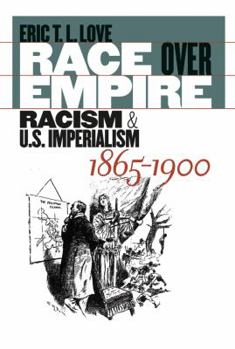
Paperback Race Over Empire: Racism and U.S. Imperialism, 1865-1900 Book

ISBN: 0807855650

ISBN13: 9780807855652

Race Over Empire: Racism and U.S. Imperialism, 1865-1900

Select Format

Select Condition ThriftBooks Help Icon

Recommended

Format: Paperback

Condition: Like New

$8.89
Save $28.61!
List Price $37.50
Almost Gone, Only 4 Left!
Save to List

Book Overview

Generations of historians have maintained that in the last decade of the nineteenth century white-supremacist racial ideologies such as Anglo-Saxonism, social Darwinism, benevolent assimilation, and the concept of the "white man's burden" drove American imperialist ventures in the nonwhite world. In Race over Empire, Eric T. L. Love contests this view and argues that racism had nearly the opposite effect.

From President Grant's attempt to acquire the Dominican Republic in 1870 to the annexations of Hawaii and the Philippines in 1898, Love demonstrates that the imperialists' relationship with the racist ideologies of the era was antagonistic, not harmonious. In a period marked by Jim Crow, lynching, Chinese exclusion, and immigration restriction, Love argues, no pragmatic politician wanted to place nonwhites at the center of an already controversial project by invoking the concept of the "white man's burden." Furthermore, convictions that defined "whiteness" raised great obstacles to imperialist ambitions, particularly when expansionists entered the tropical zone. In lands thought to be too hot for "white blood," white Americans could never be the main beneficiaries of empire.

What emerges from Love's analysis is a critical reinterpretation of the complex interactions between politics, race, labor, immigration, and foreign relations at the dawn of the American century.

Customer Reviews

2 ratings

Benevolent Assimilation?

Conventional wisdom argued that in the final decades of the nineteenth century, white-supremacist racial ideologies and sentiments such as benevolent assimilation, the "white man's burden" inspired and motivated American imperialist projects in the nonwhite world. In Race over Empire, Eric T. L. Love argues that racism had the opposite effect. Race, Love writes, was merely a diversion vis-à-vis the imperialists. In fact, "in an era marked by as much racial fear, hatred, reaction, and violence as the last decades of the nineteenth century . . . no pragmatic politician or party would fix nonwhites at the center of its imperial policies" (Love, Race over Empire xii). With the Filipino rebellion that followed the Spanish-American War just over the imperialists realized that by taking only the land needed for economic and military use, "the benefits of empire could be had without the entanglements attached to race" (Love, Race over Empire 200). What come to presence from Love's analysis is a more complex and critical reinterpretation of interrelations between politics, race, labor, immigration, and foreign relations at the start of the American century. From President Grant's move to obtain and keep the Dominican Republic in 1870, to the annexations of Hawaii and the acquisition of the Philippines in 1898, Love argues that the imperialist relationship vis-à-vis racist ideologies of the time was hostile, not friendly. In an era exemplified by the end of reconstruction, by Jim Crow, by lynching, by Chinese exclusion, and immigration restriction, Love posits, that no sensible politician wanted to situate nonwhites at the center of an already contentious project by conjuring up the notion of the "white man's burden." In addition, the idea of "whiteness" raised obstructions to imperialist ambitions, particularly in the tropics. In lands argued to be "too hot" for "white blood," Love argues that white Americans could never be the main beneficiaries of empire.

Brave & Original

I first read a review of this book in the Journal of Southern History, which reported that Race Over Empire is "that rare book that will fundamentally change how U.S. historians approach an important topic - in this case, American imperialism in the late 19th century." I couldn't agree more. This book doesn't take the easy way out - suggesting that racism facilitated U.S. imperialism. Instead, it takes a brave and original approach, discussing racist patterns and institutions within the United States, and how they acted as OBSTACLES to imperial expansion. This is something new and important. After this, no writer can credibly follow that old interpretation - that racism facilitated empire. A must read for any serious scholar of history.
Copyright © 2026 Thriftbooks.com Terms of Use | Privacy Policy | Do Not Sell/Share My Personal Information | Cookie Policy | Cookie Preferences | Accessibility Statement
ThriftBooks ® and the ThriftBooks ® logo are registered trademarks of Thrift Books Global, LLC

GoDaddy Verified and Secured