


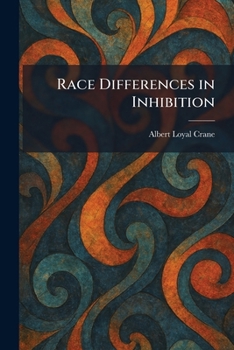
Race Differences in Inhibition

"Race Differences in Inhibition" presents an empirical study within the field of experimental psychology, specifically investigating the psychological concept of inhibition and its variance among different demographic groups. Conducted by Albert Loyal Crane, this work utilizes experimental methods to explore how individuals react to stimuli and the cognitive mechanisms involved in suppressing specific behaviors or responses.
The text delves into the physiological and psychological aspects of self-control and reaction times, providing a detailed analysis of data collected through various laboratory tests. As a significant document in the history of psychology and behavioral science, it reflects the early 20th-century preoccupation with quantifying human traits and comparing psychological attributes through a lens that was common in the academic circles of the time.
Researchers interested in the evolution of psychological testing, the history of social sciences, and the development of cognitive theory will find this work to be a primary source of data and methodology from the 1920s. By examining the interplay between biology and behavior, "Race Differences in Inhibition" offers insight into the foundational period of comparative psychology and the methodologies used to study complex human behaviors during the interwar years.
This work has been selected by scholars as being culturally important, and is part of the knowledge base of civilization as we know it. This work was reproduced from the original artifact, and remains as true to the original work as possible. Therefore, you may see the original copyright references, library stamps (as most of these works have been housed in our most important libraries around the world), and other notations in the work.
This work is in the public domain in the United States of America, and possibly other nations. Within the United States, you may freely copy and distribute this work, as no entity (individual or corporate) has a copyright on the body of the work.
As a reproduction of a historical artifact, this work may contain missing or blurred pages, poor pictures, errant marks, etc. Scholars believe, and we concur, that this work is important enough to be preserved, reproduced, and made generally available to the public. We appreciate your support of the preservation process, and thank you for being an important part of keeping this knowledge alive and relevant.
Customer Reviews
ThriftBooks ® and the ThriftBooks ® logo are registered trademarks of Thrift Books Global, LLC
