


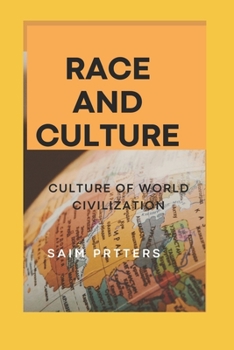
Race and Culture: Culture of World Civilization
No Customer Reviews

Regarding "Race and History" and the "first truths" he claims to have presented in it, Levi Strauss states to Eribon: "In short I tried to reconcile the concept of progress with cultural relativism," attempting to "shift the center of gravity of the problem"9. The concept of progress is familiar to us, especially when this "us" implies the West. Once the multiplicity and diversity of cultures were established, everything happens as if the West was considered an instrument for evaluating the "cultural" level achieved in each of them. Basic reference, since the era of the industrial revolution of the 190th century, remains a degree of cultural progress that is fully identified with the degree of technical progress. Let's look at the question, originally set by UNESCO, of "the contribution of human races to world civilization". It is doubly problematic. On the one hand, because it invokes an elusive global culture whose basic interest, if it existed, would be based on an irreparable attraction to differentiation that it would not fail to manifest. On the other hand, because the commitment to the struggle against racial prejudice that was proposed to people of faith at the beginning of the fifties posits precisely the existence of races as a starting point.
Format:Paperback
Language:English
ISBN:B0BBY2JKZB
ISBN13:9798847938624
Release Date:August 2022
Publisher:Independently Published
Length:200 Pages
Weight:0.60 lbs.
Dimensions:0.4" x 6.0" x 9.0"
Related Subjects
HistoryCustomer Reviews
0 rating
Copyright © 2026 Thriftbooks.com Terms of Use
| Privacy Policy | Do Not
Sell/Share My Personal Information | Cookie Policy | Cookie Preferences | Accessibility Statement
ThriftBooks® and the ThriftBooks® logo are registered trademarks of Thrift Books Global, LLC
ThriftBooks® and the ThriftBooks® logo are registered trademarks of Thrift Books Global, LLC
