


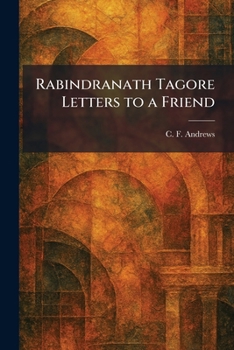
Rabindranath Tagore Letters to a Friend

"Rabindranath Tagore Letters to a Friend" is a profound collection of correspondence between the Nobel Prize-winning Indian polymath Rabindranath Tagore and his close friend and associate, C. F. Andrews. Spanning a transformative period in global history, these letters offer a rare and intimate glimpse into the mind of one of the early twentieth century's most significant thinkers.
Through their private exchanges, readers gain insight into Tagore's deep reflections on spirituality, education, universalism, and the complex political landscape of colonial India. The collection documents the deep bond of friendship and mutual respect between the two men, revealing the personal struggles and triumphs of Tagore as he navigated his role as a global intellectual and cultural ambassador. Each letter serves as a testament to Tagore's poetic vision and his unwavering commitment to the unity of mankind.
This volume provides invaluable context for understanding Tagore's broader literary and philosophical contributions, making it an essential resource for those interested in South Asian history, literature, and the philosophical bridge between East and West. It remains a poignant record of a friendship built on shared values and a tireless pursuit of truth.
This work has been selected by scholars as being culturally important, and is part of the knowledge base of civilization as we know it. This work was reproduced from the original artifact, and remains as true to the original work as possible. Therefore, you may see the original copyright references, library stamps (as most of these works have been housed in our most important libraries around the world), and other notations in the work.
This work is in the public domain in the United States of America, and possibly other nations. Within the United States, you may freely copy and distribute this work, as no entity (individual or corporate) has a copyright on the body of the work.
As a reproduction of a historical artifact, this work may contain missing or blurred pages, poor pictures, errant marks, etc. Scholars believe, and we concur, that this work is important enough to be preserved, reproduced, and made generally available to the public. We appreciate your support of the preservation process, and thank you for being an important part of keeping this knowledge alive and relevant.
Customer Reviews
ThriftBooks ® and the ThriftBooks ® logo are registered trademarks of Thrift Books Global, LLC
