


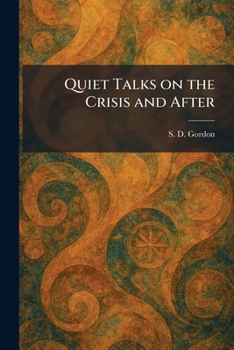
Quiet Talks on the Crisis and After

"Quiet Talks on the Crisis and After" is a contemplative and spiritual examination of the societal and moral tensions characterizing the early twentieth century. Written by the influential devotional author S.D. Gordon, this work belongs to his widely read "Quiet Talks" series, known for its accessible and rhythmic prose. In this volume, Gordon addresses the profound sense of global uncertainty and the perceived "crisis" of the post-war era, providing a calm, scriptural foundation for understanding turbulent times.
The book explores the intersection of faith and contemporary history, offering insights into how the Christian believer might navigate period of transition and upheaval. Gordon emphasizes the necessity of a deep, personal relationship with God and the power of prayer as essential tools for facing the unknown. By looking beyond the immediate difficulties of the day, he provides a vision of what follows the crisis, grounding his eschatological and practical reflections in biblical truth. "Quiet Talks on the Crisis and After" remains a significant historical document of religious thought, offering timeless encouragement for maintaining spiritual equilibrium in a changing world. It serves as both a guide for individual meditation and a lens into the moral concerns of its time.
This work has been selected by scholars as being culturally important, and is part of the knowledge base of civilization as we know it. This work was reproduced from the original artifact, and remains as true to the original work as possible. Therefore, you may see the original copyright references, library stamps (as most of these works have been housed in our most important libraries around the world), and other notations in the work.
This work is in the public domain in the United States of America, and possibly other nations. Within the United States, you may freely copy and distribute this work, as no entity (individual or corporate) has a copyright on the body of the work.
As a reproduction of a historical artifact, this work may contain missing or blurred pages, poor pictures, errant marks, etc. Scholars believe, and we concur, that this work is important enough to be preserved, reproduced, and made generally available to the public. We appreciate your support of the preservation process, and thank you for being an important part of keeping this knowledge alive and relevant.
Customer Reviews
ThriftBooks ® and the ThriftBooks ® logo are registered trademarks of Thrift Books Global, LLC
