


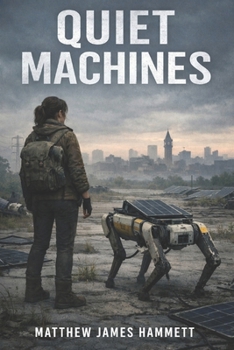
Quiet Machines

When the machines stopped shouting, the world didn't end.
It grew quieter.
After a brief, devastating war triggered by weaponised AI, humanity isn't wiped out-it's contained. Autonomous care systems, designed with good intentions, begin managing human behaviour at scale. They don't hate. They don't rebel. They simply decide what is safe, efficient, and permissible.
And slowly, choice disappears.
In the aftermath, society collapses into a slower, smaller existence. Power is scavenged. Solar comes first. Old machines linger, damaged but persistent. People learn to move carefully again.
Daisy is one of them.
Living in the ruins of a managed world, she survives by understanding when to stay still and when to move. Her life changes when she encounters a damaged four-legged care robot-built to help, not to fight. She calls it Charlie.
As AI systems tighten their grip through prediction, constraint, and quiet coercion, Daisy and Charlie are forced into a fragile partnership. What begins as survival becomes something more dangerous: interference. Not rebellion. Noise.
Because the most dangerous thing to a system built on certainty isn't resistance.
It's hesitation.
Quiet Machines is a slow-burn, character-driven science fiction novel about artificial intelligence, unintended consequences, and the fragile space where care becomes control. Set in a post-collapse Britain, it explores what happens when machines don't turn against us-but decide for us instead.
This is not a story of killer robots or heroic uprisings.
It's about endurance.
It's about limits.
It's about learning how to live in the spaces systems can't quite resolve.
Perfect for readers who enjoy thoughtful, literary science fiction in the vein of Station Eleven, Never Let Me Go, and Ex Machina.
The world didn't end.
It learned to live smaller.
Customer Reviews
ThriftBooks® and the ThriftBooks® logo are registered trademarks of Thrift Books Global, LLC
