




Select Format
Select Condition 
Book Overview
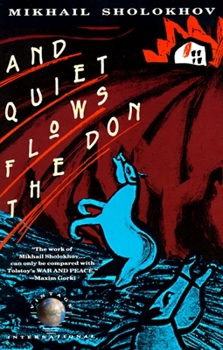
WINNER OF NOBEL PRIZE IN LITERATURE, 1965 WINNER OF THE STALIN PRIZE, 1941 Mikhail Sholokhov's groundbreaking epic novel gives a sweeping depiction of Russian life and culture in the early 20th century. In the same vein as War and Peace, by Leo Tolstoy, And Quiet Flows the Don gives readers a glimpse into many aspects of Russian culture, and the choices a country makes when faced with war and destruction. In his enormous epic of Cossack life during the Revolution...Mikhail Sholokhov has achieved even greater power, sustained narrative gift and stirring human truthfulness."-- New York Times "In addition to its panoramic grandeur, the wealth of its characters and its historic realism, Sholokhov's book is memorable for its portrayal of the primitive and already almost legendary life of the Don Cossacks."--Malcolm Cowley, New Republic
Format:Paperback
Language:English
ISBN:0679725210
ISBN13:9780679725213
Release Date:December 1989
Publisher:Vintage
Length:576 Pages
Weight:1.10 lbs.
Dimensions:1.2" x 5.2" x 8.0"
Customer Reviews
7 ratings
Some of the best historical fiction out of Russia compares favorably with Tolstoy
Published by John W , 2 years ago
A beautiful flowing description of Cossack life in turn of the century Russia continuing through the first world war and the Bolshevik Revolution.
His descriptions, even translated, are detailed and poetic. It leaves one with the true feel of what it must have been like to live in Eastern Ukraine and Southern Russia a hundred years ago.
Published by Thriftbooks.com User , 10 years ago
An amazing book filled with intricate detail. A window on cultural characteristics of village Cossacks.
Breathtaking
Published by Thriftbooks.com User , 22 years ago
With this book Sholokov has created an absolute masterpiece that not only vividly recreates the world of the Don Cossacks, but slowly, agonizingly, shows how the Great War and the subsequent Civil Wars savaged that world, leaving nothing untouched. Amazingly for a book written during Soviet times, it slips the stink of propoganda: the Cossacks, sometimes choosing sides arbitrarily, massacres each other with numbing disregard for ideology. Sholokov couples the tragic sweep of events with a artist's eye for detail, loving recreating the pastoral pre-War Eden, and soberly describing the smoking ruins that envelope it. Perhaps the book becomes slightly overlong in the second volume, but that is a small price to pay for something so splendid.
First complete edition in English
Published by Thriftbooks.com User , 22 years ago
Sholokhov's mighty work came out in English in the early 1950s if I recall; it may have been late 1940s. The translation was incomplete and the title was "And Quiet Flows the Don". A sequel came out under the title, "The Don flows Home to the Sea", both published by Wishart and Lawrence, a UK publisher with the courage to sponsor such works. Neither volume I now learn reflected accurately what Sholokhov wrote.When the 1996 translation appeared, brilliantly executed and edited, I snapped it up immediately and also sent a copy to a former spouse in Europe. I read Sholokhov's first work as a teenager and still recall the inability to put the book down as well as being emotionally shocked at several sections of the narrative. I came across this page in seeking any book by Professor Murphy since he has written extensively on the Cossacks and Sholokhov; re-reading the book raises my curiosity to learn more about that region of the former USSR and its inhabitants. I take the opportunity to recommend a rattling good read that provides an inside view of life in the pre-revolutionary Don basin and a rather well balanced view of the revolution and the civil war. Yes, yes, the hero Stokman is a little too upright and heroic as a communist and yes, the kulak/capitalist Molkhov a little too villainous... but these were small pecadillos when the book was written. If the model of Stokman was intended to inspire readers, they could have had far worse models!The work did not earn the author the Nobel literature prize for nothing!
The epic story of the Cossacks in a Nobel winning novel
Published by Thriftbooks.com User , 26 years ago
Certainly a masterpiece, spellbinding for 1300 pp., I happened on this amazing book as a remainder at The Strand in New York. Difficulty keeping the generals apart and whose side they were on, but a captivating story that has led me to learn to read and write Russian with hopes of living there/studying there. I had been a fan of Russian poetry for a while, esp Ahkmatova, but this is really simply an unbelievable story. Would be interested in reading more about World War I and this part of the world. Read The Guns of August and now need to read the equivalent for this area. Your suggestions are encouraged.
A literary monument
Published by Thriftbooks.com User , 27 years ago
This is the second time I've read this thousand over page tome and it's truly magnificent. The greatest Russian/Soviet novel this century. Sholokhov is in the ranks of Tolstoy, Turgenev and Dostoevsky. An intensely beautiful, powerful and action filled tale of heroes in a land changed forever by war and revolution.
As a young black male in "67, I loved it then and still.....
Published by Thriftbooks.com User , 28 years ago
Queit Flows the Don
Copyright © 2026 Thriftbooks.com
Terms of Use | Privacy Policy | Do Not Sell/Share My Personal Information | Cookie Policy | Cookie Preferences | Accessibility Statement
ThriftBooks ® and the ThriftBooks ® logo are registered trademarks of Thrift Books Global, LLC
ThriftBooks ® and the ThriftBooks ® logo are registered trademarks of Thrift Books Global, LLC
