


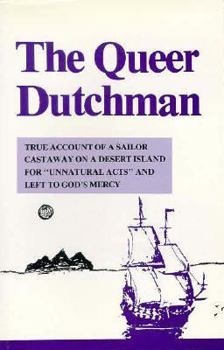
The Queer Dutchman: True Account of a Sailor Castaway on a Desert Island for Unnatural Acts and Left to God's Mercy (English and Dutch Edition)


No Synopsis Available.
Format:Paperback
Language:English
ISBN:0914018035
ISBN13:9780914018032
Release Date:January 1979
Publisher:Green Eagle Pr
Length:144 Pages
Weight:0.65 lbs.
Dimensions:8.0" x 0.5" x 5.3"
Customer Reviews
2 ratings
ABSOLUTELY FASCINATING- COULDN'T PUT THE BOOK DOWN
Published by Thriftbooks.com User , 26 years ago
STORY TAKES PLACE ON THE HIGH SEAS IN 1725. A DEEPLY RELIGIOUS SAILOR, JAN SVILT, IS MAROONED ON A DESERT ISLAND BY THE SHIP'S CAPTAIN BECAUSE OF ACCUSATIONS OF BUGGGERY,AND LEFT TO GOD'S MERCY. SVILT HAS A WIFE AND TWO DAUGHTERS IN AMSTERDAM. BAD ECONOMIC CONDITIONS IN HOLLAND DROVE HIM TO JOIN THE DUTCH EAST INDIA COMPANY AS A PURSER.
A fascinating story of suffering, well worth reading.
Published by Thriftbooks.com User , 27 years ago
The Queer Dutchman is a fascinating tale, appalling for the suffering it describes. It tells the story of a Dutch sailor set ashore alone on Ascension Island in 1725, after being accused of an affair with a boy. The book contains his daily journal written on this barren and uninhabited island "found beside his skeleton," which recounts his finally fruitless search for water during five months. There are also excerpts purportedly from his shipboard journal at Capetown and Batavia. The intriguing question is how much of this is historical fact. It's not clear from the text. The Ascension diary was first published in London in 1728 under the title "An Authentick Relation of the hardships and sufferings of a Dutch sailor..." (There is a later reissue under the title "The Just Vengeance of Heaven...," 1730, 1747, etc. which I have not seen, but which I assume is the same text.) The Ascension diary in QD repeats the material in the 1728 pamphlet, but claims to be a translation from a book of sea adventures published in Dutch in 1762 or 1803; however, since the title of the book isn't given, I haven't been able to trace it. In addition the QD version of the Ascension diary includes passages in which the sailor (whose name is Jan Svilt) reflects on his former life in Holland; these are interesting, plausible, and well written, but read like novelistic flashbacks added by the translator (M. Jelstra) or the compiler (Peter Agnos), as do the Capetown and Batavia episodes. Finally, the book includes records, purportedly from the Archives of the Dutch East India Company, of Svilt's ship-board trial which led to the decision to abandon him on Ascension, and a second report, also by the captain, of his response to a charge by the chaplain that he (the captain)had acted too leniently (!) The chaplain held that man and boy should have been thrown overboard to the sharks. (One possible punishment for sodomy in Holland in the eighteenth century was drowning.) This archival material may possibly be authentic, and could be checked in Amsterdam. I'd be interested in comments on these speculations, especially from Agnos or Jelstra.
Copyright © 2026 Thriftbooks.com Terms of Use
| Privacy Policy | Do Not
Sell/Share My Personal Information | Cookie Policy | Cookie Preferences | Accessibility Statement
ThriftBooks® and the ThriftBooks® logo are registered trademarks of Thrift Books Global, LLC
ThriftBooks® and the ThriftBooks® logo are registered trademarks of Thrift Books Global, LLC
