


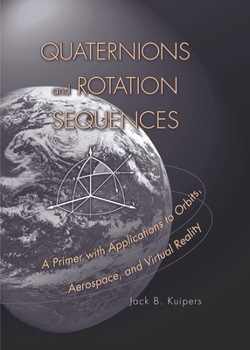
Quaternions and Rotation Sequences

Ever since the Irish mathematician William Rowan Hamilton introduced quaternions in the nineteenth century--a feat he celebrated by carving the founding equations into a stone bridge--mathematicians and engineers have been fascinated by these mathematical objects. Today, they are used in applications as various as describing the geometry of spacetime, guiding the Space Shuttle, and developing computer applications in virtual reality. In this book, J. B. Kuipers introduces quaternions for scientists and engineers who have not encountered them before and shows how they can be used in a variety of practical situations. The book is primarily an exposition of the quaternion, a 4-tuple, and its primary application in a rotation operator. But Kuipers also presents the more conventional and familiar 3 x 3 (9-element) matrix rotation operator. These parallel presentations allow the reader to judge which approaches are preferable for specific applications. The volume is divided into three main parts. The opening chapters present introductory material and establish the book's terminology and notation. The next part presents the mathematical properties of quaternions, including quaternion algebra and geometry. It includes more advanced special topics in spherical trigonometry, along with an introduction to quaternion calculus and perturbation theory, required in many situations involving dynamics and kinematics. In the final section, Kuipers discusses state-of-the-art applications. He presents a six degree-of-freedom electromagnetic position and orientation transducer and concludes by discussing the computer graphics necessary for the development of applications in virtual reality.
Format:Hardcover
Language:English
ISBN:0691058725
ISBN13:9780691058726
Release Date:December 1998
Publisher:Princeton University Press
Length:371 Pages
Weight:2.20 lbs.
Dimensions:10.5" x 1.3" x 7.8"
Related Subjects
Calculus Math Mathematics Science Science & Math Science & Scientists Science & TechnologyCustomer Reviews
5 ratings
smooth read.
Published by Thriftbooks.com User , 20 years ago
I am mostly self educated in mathematics but still had no trouble with the reasoning and topics in this book. Each topic is intuitively and rigorously explained. Quaternions are a delight, are very interesting to work with, and are suprisingly productive in use. It is hard to find a good solid text on quaternions so this book would be well appreciated to anyone interested in the subject. Brush up on your matrix algebra first, especially determinants. I would recommend this book to anyone interested in applied mathematics.
Plainest, clearest introduction around
Published by Thriftbooks.com User , 20 years ago
Latitude and longitude look simple enough, at first - just put your finger in the globe, and see which horizontal line crosses which vertical. When you start doing arithmetic, though, things get weird. Measuring longitude in degrees, 179+2=-179. In degrees latitude, 89+2=89, but the longitude changes! And, when you try to figure longitude precisely at the north pole, you run into a singularity. Believe me, you don't want to be in a plane when its navigation programs run into singularities. Those bits of strangeness all vanish when quaternions represent angles. Quaternions are a bit like complex numbers, but with three different complex parts instead of one. They have very nice mathematical properties, even better than rotation matrices, and a compact form. Kuipers gives a clear, thorough introduction to quaternions and their uses in geometric computations. Everything is explained one step at a time, giving the reader plenty of chance to back off and try again when the discussion gets thick. The buildup is very methodical, just about every derivation is carried out in steps that are easy to follow, using legible, standard notation. Kuipers uses side bars to remind the reader about the basics under more complex discussions, keeping an awareness of where a beginner might go off the rails. Since this discusses geometric computations, illustrations are profuse. The book is not for the reader in a hurry. There are lots of gems here, but you really do have to dig through a lot to find them. The illustrations contain all needed information, but it may take some effort to pick them apart. And, like any technical book, this assumes a reader with a certain background. In this case, intuition about 3D objects, trig, and linear algebra are compulsory, but I guess a sufficiently dedicated reader could substitute blind obedience to formulas for linear algebra. Ch.11-13 assumes calculus through partial differentials and ODEs, but many readers can skip these chapters without loss. This is all the how and why of quaterion representations of 3D rotations. It's gently paced, and makes only moderate assumptions about the reader's background. I've never seen this material presently so clearly, from so many angles, anywhere else. Highly recommended. //wiredweird
I am the Quaternion Book's Author
Published by Thriftbooks.com User , 21 years ago
I merely want to share with you an excellent review of my Quaternion Book. The review appeared in the Nov/Dec'03 issue of Contemporary Physics, vol6., and was written by Dr Peter Rowlands, Waterloo University, UK. The review is herewith attached (if I may) otherwise I'll paste the text). It's probably too long --- but you now know where to find it. Here goes:The following Book Review Appeared in Journal: Contemporary Physics}, Nov/Dec 2003,vol 44, no. 6, pages 536 - 537 · · · Quaternions & Rotation Sequences A Primer with Applications to Orbits, Aerospace, and Virtual Reality by JACK B. KUIPERS Princeton University Press. 2002, £24.95(pbk), pp. xxii + 371, ISBN 0 691 10298 8. Scope: Text. Level: Postgraduate and Specialist. }Quaternions are one of the simplest and most powerful tools ever offered to the physicist or engineer. Unfortunately, they are relatively little known because a centuryold prejudice (the result of a family feud involving vector theory) has been responsible for keeping them out of university courses. The fact that quaternions have never really found their true role has become a self-fulfilling prophecy, despite their reappearance in various disguised forms such as Pauli matrices, 4-vectors, and, in a complex double form, in the Dirac gamma algebra. The straightforward manipulation of this relatively simple formalism, however, means that, to a quaternionist, such things as Minkowski space-time and fermionic spin are no longermysterious unexplained physical concepts but merely inevitable consequences of the fundamental algebraic structure, while even ordinary vector algebra as David Hestenes has shown (Space-Time Algebras, Gordon and Breach, 1966) is much better understood in terms of its quaternionic base. The immense value of the quaternion algebra is that its products are ordinary algebraic products, not the dot or cross products of standard vector algebra, although they also include these concepts. Despite many statements to the contrary, quaternions are by no means short of serious applications, either. Often in highly practical contexts, and, in every application that I know of, where a quaternion formulation is possible, this formulation is invariably superior to any more `conventional' alternative. Kuipers, in his splendid book, effectively shows this in the eminently practical case of the aerospace sequence and great circle navigation by demonstrating how the same calculations are done, first by conventional matrix methods, and then by quaternions. Rather than abstractly defining quaternion algebra and then seeking possible applications, he prepares the ground well by describing the application first, and then developing the quaternion methods which will solve it. It is not until chapter 5, in fact, that quaternion algebra is seriously introduced. However, Kuipers sets this on a firm basis by establishing early on the connection with complex numbers, matrices and rotations. These subjects are discussed with gre
A Delightful Read!
Published by Thriftbooks.com User , 23 years ago
This book was a delightful read! If you ever have been curious or puzzled or even terrified by Euler angles then read this text. Many questions will be answered and muchknowledge revealed. For a gentle introduction to quaternions this is also a good placeto start. The book starts out with a review of complex numbers (in order to emphazisethe similarity to quaternions later on), then reviews rotations and matrix methods(sorry but vectors don't do rotations) and then gets into the nitty-gritty of rotations in 2-space and on into 3-space. Three problems involving rotations arediscussed in detail. All of this at first with matrix methods and then a nice easyintroduction to quaternions is given and these three problems are then handled withquaternions. There is a strong comparison made between compex number arithmetic andquaternion arithmetic, such as norms, conjugates and computation of multiplicativeinverses. Ever wonder how far it is between say Dallas and London? And what directionto take to go from to the other? Well, airplanes do it every day but if I were askedthat question on an exam I would have flunked it. Not anymore! The explanation ofthe answer to such questions is presented in a simple/y delightful manner in thistext. There is also stuff here on spherical trigonometry and a description of anorientation and distance sensing system, using the near field pattern of magnetic dipoleantennas. Finally there is discussion of ordinary differential equations and anoverview of what is needed for displaying moving objects with computer graphics.Well, that is quite a lot, but the pace is easy going and the text takes this intoaccount by reproducing say the equation or the figure under discussion in the marginsas it goes along. A very well executed text, no constant back-paging to figure outwhat we were talking about! The text has the flavor being written from lecture notes, not the usual crypticones, but well expanded and well thought out ones. This leads to some repetition but that's O.K. by me. It makes easy reading for a varied audience. Who is this text aimed at? Well I did find it enlightening even with a backgroundin physics and a rudimentary introduction to Euler angles in an advanced classical mechanics course, but I never had the occasion to use them in my career, so this wasa good refresher for me. What do you need to know to get something out of this text?A good grip on the meaning of sines and cosines and the various addition andmultipication formulas or at least know where to look them up. A little knowledge ofvectors, the dot and cross product will also be handy even though it is explained in the text. For one chapter a smattering of differential calculus is useful and for another a whole lot of knowledge about differential equations, more than I have is needed. But if you don't have this background you can safely skip these parts and not loose any of the further stuff in the text. You should know how to solve sets ofsimultaneous equa
An oustanding work on rotations for the practitioner
Published by Thriftbooks.com User , 26 years ago
My graduate school work was in theoretical quantum mechanics, and was especially concentrated in the group properties of rotations. I can honestly say that I would have been twice as effective if I had this reference available then.Kuiper does an outstanding job of pulling together the traditional matrix-based approach to describing rotations with the less-frequently encountered quaternion approach. In doing so, he clearly shows the benefits of the quaternion algebra, especially for computer systems modeling rigid body rotations and virtual worlds. The exposition is clear, concise, and aimed at the practitioner rather than the theoretician. The examples are taken from classical engineering problems -- a refreshing change from the quantum-mechanical problems I was used to from previous works on the subject.Despite the practical foocus, though, there is plenty of material here for those more interested in understanding the minutia of the SO(3) symmetry group. And unlike most work in this field, he doesn't stop with algebra, but includes the calculus of rotation matrices and quaternions using material on kinematics and dynamics of rigid bodies, celestial mechanics, and rotating reference frames. I give the book my highest recommendation. It should be considered an essential reference work for anyone who encounters rotational problems with any frequency.--Tony Valle
Copyright © 2025 Thriftbooks.com
Terms of Use | Privacy Policy | Do Not Sell/Share My Personal Information | Cookie Policy | Cookie Preferences | Accessibility Statement
ThriftBooks ® and the ThriftBooks ® logo are registered trademarks of Thrift Books Global, LLC
ThriftBooks ® and the ThriftBooks ® logo are registered trademarks of Thrift Books Global, LLC
