


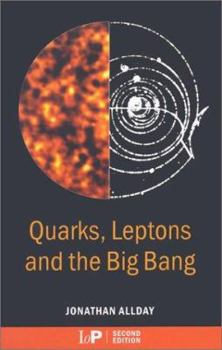
Quarks, Leptons and The Big Bang, Second Edition

Select Format
Select Condition 
Book Overview
Quarks, Leptons and The Big Bang is a clear, readable and self-contained introduction to particle physics and related areas of cosmology. It bridges the gap between non-technical popular accounts and textbooks for advanced students. The book concentrates on presenting the subject from the modern perspective of quarks, leptons and the forces between them. This book will be of interest to students, teachers and general science readers interested in fundamental ideas of modern physics.
Format:Paperback
Language:English
ISBN:0750308060
ISBN13:9780750308069
Release Date:December 2001
Publisher:CRC Press
Length:442 Pages
Weight:1.38 lbs.
Dimensions:8.3" x 1.0" x 5.5"
Customer Reviews
4 ratings
A different path
Published by Thriftbooks.com User , 19 years ago
I recently lost this book trying to get too many things at once through an airport and have ordered another copy. Not only is this book the type of bridge (between the usual popular words-only description of this subject matter and an upper level/graduate text) that us interested engineers find useful, it is highly recommended for completely dropping the semi-historic approach. Instead this author just starts off with what is known about fundemental physics at the day he writes and goes from there. Although this book can in no sense equip you to "do" particle physics, it creates a semi-quantitative understanding that attaches itself much more completely to my brain than the normal eloquent hand waving. After studying this, I remembered the old New Yorker carton showing a gnomish character reading a huge tome at a library table exclaiming " Suddenly there, for a moment, it all made sense" There is a similar, and I hope not too illusory, experience after reading Mr. Allday's little book.
Demister for the brain
Published by Thriftbooks.com User , 22 years ago
I had read various books and articles on particle physics, but a lot of the terms were just swimming around in my head and I didn't have a very clear idea of what was what. This book presents the different kinds of particles, forces and possible reactions very clearly, and with some very amusing footnotes to boot. Thanks to this explanation I really feel like I understand where all the particles fit in. I will definitely be checking out Allday's other books. Now I just need to find a book with more mathematics in it as a follow-on.
A bright & cheerful light on Particles and Cosmology
Published by Thriftbooks.com User , 24 years ago
Dr. Allday's book is a completely charming presentation of particle physics and cosmology. Although not a textbook--there are no exercises--it presumes a physics background, starting, say, at the 3rd year. Most of the book deals with the Standard Model of particle physics, but GUTS and supersymmetry are briefly mentioned. The last 2 chapters cover cosmology up to 1998. (Unfortunately, the author just missed the opportunity of including the acceleration of the cosmic expansion that was deduced by 2 groups in that year based on supernovae observations. But this is a tiny caveat: since the cosmic acceleration remains yet undigested by theorists, it could have earned only a passing mention had it been included.) Two related features of the book are worthy of special mention: a) the pedagogy is *first rate* (even the early chapters surveying Special Relativity and Quantum Mechanics--those old, overly- familiar staples of Physics--were presented in ways fresh and original), and b)the author's kindly solicitude for his readers shines through on almost every page--something hardly in evidence among science books I've read! The author is simply an excellent teacher and illuminates the subject at every turn. If, like myself, you've had some bad experiences with "semi-popular" articles on particle physics--whether ,e.g., in Scientific American or Physics Today--that purported to cater to the general Physicist but quickly proved otherwise, then you might give Allday's book a try. And Physics popularizers of every ilk, please take note: if you want to do a better job in future and add to the happiness of your readers,"Quarks, Leptons, and the Big Bang" sets a high water mark suitable for calibrating your best efforts.
Allday's Quarks, Leptons, and the Big Bang
Published by Thriftbooks.com User , 25 years ago
This is one of the best SUMMARY books in advanced physics (especially cosmology and elementary particle theory) that I have ever read. It is impossible to read Allday without finding unusually detailed summaries in every chapter, each of which is enough to form the outline of several lectures if not a course. This ability to summarize information in detail for non-specialists is generally a sign of what I call the Creative Genius as opposed to the Ingenious Follower in physics and mathematics, although there are some exceptions. It is more common among European authors (especially British, German, French, Belgian) and Canadian, Australian and American authors from about Chicago or Texas eastward (don't ask me why, or I will go into a long discussion that will last for years). Several publishing companies specialize in it: Springer-Verlag/Springer, Cambridge University Press, Oxford University Press/Clarendon to a lesser extent. There is a disadvantage to it in that the author sometimes leaves out open research questions of the last few years (as Allday unfortunately does). Kluwer/Plenum and Wiley and Chapman-Hall/Longmans are better in this respect, being oriented toward the latest open questions. The American Mathematical Society publishes in both of the above categories, and the reader should purchase their books whenever they appear. If the reader lacks mathematical or physics specialization, a reputable consultant or tutor should be hired to help translate into ordinary English (a rare ability which is also associated with Creative Genius in my opinion).
Copyright © 2026 Thriftbooks.com Terms of Use
| Privacy Policy | Do Not
Sell/Share My Personal Information | Cookie Policy | Cookie Preferences | Accessibility Statement
ThriftBooks® and the ThriftBooks® logo are registered trademarks of Thrift Books Global, LLC
ThriftBooks® and the ThriftBooks® logo are registered trademarks of Thrift Books Global, LLC
