


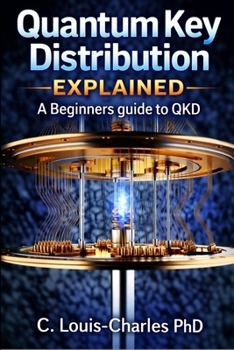
Quantum Key Distribution Explained: A Beginner's Guide to the Physics of Unbreakable Keys (QKD)
No Customer Reviews

Please Note: "Zero Math, Zero Physics, Zero Prior Crypto Experience Required" A new kind of computer is coming-one that can tear through the math protecting today's encrypted data. If your organization depends on long-lived secrets, from financial records to government archives, you cannot afford to wait until that happens to rethink how you keep information safe. This book is a clear, concept-first guide to quantum key distribution (QKD), the physics-based approach to secure key exchange that does not rely on "hard math" staying hard forever.
Inside this book, readers will learn how to: Understand secrets, keys, and encryption without needing equations or prior security trainingSee why quantum computers threaten today's public-key systems and long-term confidentialityGrasp photons, polarization, superposition, and measurement as they apply directly to QKDFollow the BB84 protocol step by step, from random photons to a shared secret keyRecognize how eavesdroppers are detected automatically through error rates and samplingConnect the dots from lab-scale QKD to real hardware, fiber links, and satellite networksEvaluate where QKD is being deployed today in banking, government, and critical infrastructureIdentify the honest limitations of QKD, including hardware cost, distance, and trusted nodesCompare QKD with post-quantum cryptography and see why the future uses both togetherNavigate emerging ideas like quantum repeaters and the vision of a quantum internetCovers August 2024 NIST PQC final standards and 2024-2026 Micius and EuroQCI rollouts, also covers Harvest-Now-Decrypt-later threat modelAcross twelve tightly structured chapters, the book starts with everyday padlock stories and browser padlock icons, then builds toward the quantum world only as far as readers actually need to go. Encryption, keys, and the key distribution problem are explained in plain language, showing why "sharing a secret over an untrusted network" has been the central difficulty in cryptography for centuries. From there, the narrative introduces photons, polarization, superposition, and the no-cloning rule as practical tools, not abstract mysteries. The heart of the book walks through how QKD really works. Readers meet Alice, Bob, and Eve; watch random photons travel down a quantum channel; see how random measurement choices create matching and mismatching bits; and learn how sifting, error checking, and privacy amplification turn noisy raw data into a clean secret key. The detection guarantee-any eavesdropper leaves a statistical fingerprint-is treated as a concrete engineering property, not a slogan. Later chapters move from theory to deployment. They explore single-photon sources, decoy-state methods, fiber-based links, and satellite relays, then survey real quantum networks on the ground and in orbit. Case studies highlight why banks, governments, data centers, and healthcare systems care about quantum-safe key exchange, and why many other applications still do not adopt QKD today.
A dedicated chapter covers QKD's limits, including authentication gaps, cost, distance, implementation attacks, denial-of-service risks, and trusted-node trade-offs. Another compares QKD with post-quantum cryptography, explaining why robust security strategies increasingly use both. The closing chapters look ahead to quantum repeaters, entanglement-based QKD, and the long-term vision of a quantum internet, while offering grounded guidance on how to keep learning without getting swept up in hype. For managers, students, and curious professionals, this is a practical roadmap to understanding quantum key distribution well enough to ask sharper questions, make better decisions, and treat quantum security as a strategic topic-not a buzzword.
Inside this book, readers will learn how to: Understand secrets, keys, and encryption without needing equations or prior security trainingSee why quantum computers threaten today's public-key systems and long-term confidentialityGrasp photons, polarization, superposition, and measurement as they apply directly to QKDFollow the BB84 protocol step by step, from random photons to a shared secret keyRecognize how eavesdroppers are detected automatically through error rates and samplingConnect the dots from lab-scale QKD to real hardware, fiber links, and satellite networksEvaluate where QKD is being deployed today in banking, government, and critical infrastructureIdentify the honest limitations of QKD, including hardware cost, distance, and trusted nodesCompare QKD with post-quantum cryptography and see why the future uses both togetherNavigate emerging ideas like quantum repeaters and the vision of a quantum internetCovers August 2024 NIST PQC final standards and 2024-2026 Micius and EuroQCI rollouts, also covers Harvest-Now-Decrypt-later threat modelAcross twelve tightly structured chapters, the book starts with everyday padlock stories and browser padlock icons, then builds toward the quantum world only as far as readers actually need to go. Encryption, keys, and the key distribution problem are explained in plain language, showing why "sharing a secret over an untrusted network" has been the central difficulty in cryptography for centuries. From there, the narrative introduces photons, polarization, superposition, and the no-cloning rule as practical tools, not abstract mysteries. The heart of the book walks through how QKD really works. Readers meet Alice, Bob, and Eve; watch random photons travel down a quantum channel; see how random measurement choices create matching and mismatching bits; and learn how sifting, error checking, and privacy amplification turn noisy raw data into a clean secret key. The detection guarantee-any eavesdropper leaves a statistical fingerprint-is treated as a concrete engineering property, not a slogan. Later chapters move from theory to deployment. They explore single-photon sources, decoy-state methods, fiber-based links, and satellite relays, then survey real quantum networks on the ground and in orbit. Case studies highlight why banks, governments, data centers, and healthcare systems care about quantum-safe key exchange, and why many other applications still do not adopt QKD today.
A dedicated chapter covers QKD's limits, including authentication gaps, cost, distance, implementation attacks, denial-of-service risks, and trusted-node trade-offs. Another compares QKD with post-quantum cryptography, explaining why robust security strategies increasingly use both. The closing chapters look ahead to quantum repeaters, entanglement-based QKD, and the long-term vision of a quantum internet, while offering grounded guidance on how to keep learning without getting swept up in hype. For managers, students, and curious professionals, this is a practical roadmap to understanding quantum key distribution well enough to ask sharper questions, make better decisions, and treat quantum security as a strategic topic-not a buzzword.
Format:Paperback
Language:English
ISBN:B0H4B4R17P
ISBN13:9798904980979
Release Date:June 2026
Publisher:Cybersoft Publishing LLC
Length:476 Pages
Weight:1.39 lbs.
Dimensions:1.0" x 6.0" x 9.0"
Customer Reviews
0 rating
Copyright © 2026 Thriftbooks.com
Terms of Use | Privacy Policy | Do Not Sell/Share My Personal Information | Cookie Policy | Cookie Preferences | Accessibility Statement
ThriftBooks ® and the ThriftBooks ® logo are registered trademarks of Thrift Books Global, LLC
ThriftBooks ® and the ThriftBooks ® logo are registered trademarks of Thrift Books Global, LLC
