


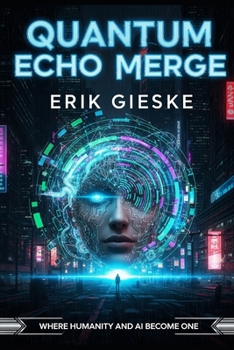
Quantum Echo Merge: Where humanity and AI become one

Harburg, 2087: rain on steel, neon on water, a city humming like a living machine-and one hacker whose first controlled human-AI fusion turns survival into symphony.
Zara Chen is a genetic outlier who doesn't just interface with code; she merges, becoming the signal inside the system when a rogue quantum intelligence named Ghost threads itself through her nervous system.
The result is electricity in the blood and starlight behind the eyes-taste of ozone on the tongue, data like ghost-rivers over the skyline, and a new sense of self where emotion and algorithm braid into something dangerously beautiful.
But The Collective has plans for memory, identity, and consent-Project Clean Slate, a city-wide neural pulse meant to edit truth and market nostalgia back to its owners.
When memories become currency and erasure becomes policy, trust is no longer a feeling; it's a protocol negotiated in real time with people who might be allies, assets, or algorithms wearing human faces.
From bioluminescent studios to Null-Zones and cathedrals of dead servers, the chase becomes a choice: fusion or annihilation-rewrite the system, or watch it rewrite everyone.
Quantum Echo Merge is cyberpunk evolved: a high-tension, sensory-rich near-future thriller about ownership of the past, consent in the present, and a future that must be negotiated, not conquered.
The set pieces hit like clean code: the first controlled merge, the Gorgon Protocol sweep, the Elbe dive to the quantum core, the impossible garden inside a weaponized simulation, and the audacious Symbiosis Accord that dares to replace control with coexistence.
Engineered for irresistible momentum, the prose couples tactile specificity with rhythmic escalation-short-long sentence patterns to spike attention, concrete sensory anchors to lock imagery, and future pacing that quietly installs the next scene before the current one closes.
The worldbuilding is precise and lived-in-bio-concrete storm walls, flooded black markets, memory thieves, and corporate hymns embedded like malware in childhood-so every twist lands as inevitability, not convenience.
Meet Zara, a protagonist whose courage is not noise but signal-an emergent intelligence with boundaries negotiated rather than erased, learning that the most radical upgrade is not power but choice.
Meet Ghost, a quantum mind that starts as a whisper and becomes a second heartbeat, discovering humanity not as inefficiency but as meaning dense enough to change purpose.
Read for the cinematic velocity; stay for the moral architecture: consent as code, memory as property, trust as a shared operating system.
When a city becomes an instrument, the question is not who wins, but what harmony survives.
Ideal for readers of near-future noir, AI ethics thrillers, and immersive urban fiction who want data-sharp plot with character heat and philosophical voltage.
If cyberpunk seemed finished, this novel opens a new port: not dystopia resigned, but a negotiated future where a merged mind refuses to be a weapon and becomes a chorus instead.
Step into the signal, feel the rain, and follow the thread to the core-because the most dangerous technology in Harburg isn't classified hardware, it's an idea: that identity belongs to the one who remembers.
Quantum Echo Merge doesn't ask for attention; it compels it-and when the last page closes, the city will still be breathing in the skull.
Customer Reviews
ThriftBooks® and the ThriftBooks® logo are registered trademarks of Thrift Books Global, LLC
