


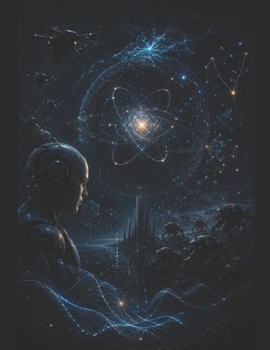
Quantum-AI-Robotics Convergence: A Unified Engineering and Computational Approach Vol-II: From Theory to Deployment: Algorithms, Architectures, and Ap

What happens when classical robotics reaches the limits of deterministic control?
Quantum Robotics and Autonomous Swarm Intelligence presents a bold, interdisciplinary framework for engineering next-generation autonomous systems through the fusion of:
quantum-inspired computation, probabilistic control theory, swarm intelligence, distributed optimization, reinforcement learning, tensor architectures, and cyber-physical infrastructure design.Spanning high-dimensional Hilbert spaces, density operators, tensor manifolds, variational optimization, edge-to-QPU pipelines, decentralized swarm coordination, post-quantum cryptography, self-healing topologies, and emergent machine agency, this work explores how future autonomous systems may operate beyond the constraints of rigid binary architectures.
Rather than treating intelligence as a sequence of deterministic state transitions, this series develops a unified systems-engineering perspective in which autonomous agents navigate probabilistic state spaces under uncertainty, synchronization pressure, entropy constraints, and distributed environmental interaction.
Inside these volumes, readers will explore:
Quantum-inspired robotics architecturesTensor decomposition for multi-agent systemsProbabilistic state estimation & Bayesian controlQuantum walks & QAOA trajectory optimizationVariational learning systems & barren plateausSwarm Hamiltonians & distributed synchronizationEdge orchestration & autonomous infrastructureCryogenic machinery & quantum-adjacent hardwareError correction & self-healing topologiesPost-quantum swarm cryptographyEthical manifolds & machine agencyCombining mathematical formalism, engineering architecture, implementation logic, and cinematic systems philosophy, Quantum Robotics and Autonomous Swarm Intelligence occupies a unique space between advanced robotics engineering, quantum-inspired systems design, and speculative technological futures.
Designed for:
AI researchers, robotics engineers, distributed systems architects, autonomous systems developers, advanced technology enthusiasts, and readers seeking visionary frameworks for the future of intelligent machines.This is not merely a book about robots.
It is an exploration of how intelligence itself may evolve when probability, coordination, and computation converge.
Customer Reviews
ThriftBooks ® and the ThriftBooks ® logo are registered trademarks of Thrift Books Global, LLC
