


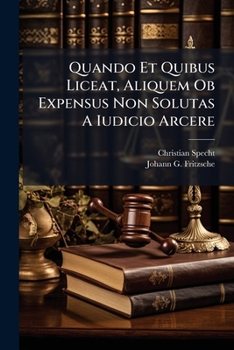
Quando Et Quibus Liceat, Aliquem Ob Expensus Non Solutas A Iudicio Arcere

"Quando Et Quibus Liceat, Aliquem Ob Expensus Non Solutas A Iudicio Arcere," by Christian Specht and Johann G. Fritzsche, delves into historical legal principles concerning the barring of individuals from judicial proceedings due to unpaid expenses. This scholarly work explores the conditions and circumstances under which such restrictions were permissible, offering insights into the legal practices and thought of its time.
The book examines the nuances of civil law and its application in historical contexts, making it a valuable resource for legal historians and scholars of European history. It provides a detailed analysis of the judicial processes related to debt and financial obligations, shedding light on how legal systems addressed these issues in the past. This enduring work remains relevant for understanding the evolution of legal thought and the historical foundations of contemporary legal practices.
This work has been selected by scholars as being culturally important, and is part of the knowledge base of civilization as we know it. This work was reproduced from the original artifact, and remains as true to the original work as possible. Therefore, you will see the original copyright references, library stamps (as most of these works have been housed in our most important libraries around the world), and other notations in the work.
This work is in the public domain in the United States of America, and possibly other nations. Within the United States, you may freely copy and distribute this work, as no entity (individual or corporate) has a copyright on the body of the work.
As a reproduction of a historical artifact, this work may contain missing or blurred pages, poor pictures, errant marks, etc. Scholars believe, and we concur, that this work is important enough to be preserved, reproduced, and made generally available to the public. We appreciate your support of the preservation process, and thank you for being an important part of keeping this knowledge alive and relevant.
Customer Reviews
ThriftBooks ® and the ThriftBooks ® logo are registered trademarks of Thrift Books Global, LLC
